


Interview: Jamie Rowe – A New Chapter with Kalamity Kills
For many listeners in the Christian rock and metal world, the name Jamie Rowe is inseparable from the legacy of Guardian. During the late 1980s and throughout the 1990s, Guardian became one of the most recognizable melodic hard rock bands in Christian music. Albums such as Fire and Love, Miracle Mile, and Swing, Swang, Swung helped define the era, blending arena-ready hooks with a bold message of faith. At the center of it all was Rowe’s unmistakable voice, a vocalist capable of delivering soaring melodies and emotional conviction.
Rowe’s musical journey stretches far beyond one band. Over the decades he has been involved with projects including AdrianGale, Tempest, and the tribute project London Calling, while also contributing to recordings and collaborations throughout the Christian rock community. His voice has appeared alongside or in connection with artists and projects such as Rock Power Praise, X-Sinner, J.C. Crew, Petra, Crystavox, Scott Wenzel, Bride, Midnight Orchestra, Raze, TobyMac, Liberty N’ Justice, Sonicflood, Whitecross, Applehead, and more. Rowe has also participated in projects connected to gospel legend Andraé Crouch & All-Star Choir, further highlighting the wide range of musical environments he has worked within.
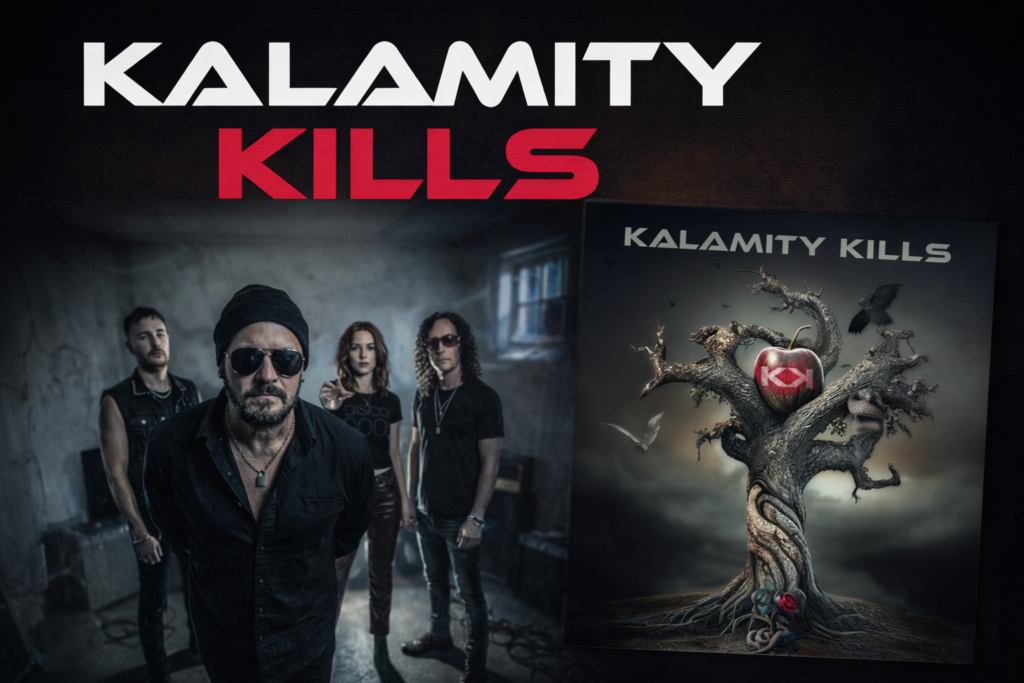
Now he enters another new chapter with Kalamity Kills. While the band first emerged a few years ago, the self-titled album Kalamity Kills was originally released in 2023 and continues to reach new audiences as a modern hard rock statement. The record represents a shift in tone and intensity while still retaining the melodic instincts that have defined Rowe’s voice throughout his career.
The band itself brings together musicians with deep musical histories. Guitarist Jeremy has worked across multiple genres, including joining LeAnn Rimes’ band as a guitarist in 2000 and later working with Vanessa Williams in 2004. The project also includes contributions from well-known voices in Christian rock, including Luke Easter of Tourniquet, who provides backing vocals on the track “Anthem.”
Together, the musicians behind Kalamity Kills have created a record that feels both personal and current. Rather than revisiting past formulas, the album reflects where Rowe is today as an artist, songwriter, and person.
In the conversation below, Rowe reflects on the creative freedom behind the Kalamity Kills debut, the challenge of stepping outside the expectations tied to his past work, and the deeper themes shaping his writing today.
How did your mindset entering the Kalamity Kills debut differ from the way you approached classic Guardian records?
With Guardian, there was always this sense of working within a framework. The band identity had been established, there was a fan base with certain expectations, and honestly there was a label structure that had its own opinions about direction.
Coming into Kalamity Kills, I felt this almost unsettling freedom. There was no blueprint. No one was waiting for me to sound a certain way. That was both liberating and terrifying.
I approached it the way I wish I could have approached every record, just asking myself what excites me right now, what moves me, and what I actually want to say. It was creatively the most honest I have ever been walking into a studio.
Working with Jamey Perrenot was key because we are friends outside of music. He knows me and he gets me.
Was there any pressure, internal or external, to revisit a familiar sound versus pushing into something more current and aggressive?
The internal pressure was the loudest voice, honestly. Decades of being identified with a certain sound creates grooves in your thinking that are hard to step out of.
There were moments where I would catch myself defaulting to what felt safe. Melodic, radio friendly, polished in that classic way. I had to consciously push back against that.
Externally, some people in my circle were curious whether I would lean into the nostalgia angle, and I understood why. But I did not want to make a record that belonged to twenty or thirty years ago. I wanted to make something that belonged to right now and to who I am today.
The self titled record has a modern hard rock edge but still carries your melodic instincts. How intentional was that balance?
Very intentional, though intentional makes it sound more calculated than it felt. It was more like a negotiation between the musician I have always been and the music I am genuinely listening to today.
I am not going to pretend my melodic instincts are not deeply wired into me. They are. But the aggression and the weight of the guitars reflect where I am emotionally and the music I enjoy from others these days.
Life has a certain heaviness to it at this stage, and I wanted the music to carry that honestly. The melody was never going away, but it needed a harder frame.
Songs like “Afraid” feel both vulnerable and defiant. What personal experiences shaped that track?
That song came from a very real place of wrestling with fear. Not in an abstract sense, but the kind of fear that shows up at three in the morning when you are questioning your worth, your relevance, your relationships, and your faith.
The defiance in it is not bravado. It is more like refusing to let fear have the last word, even when it is screaming the loudest.
I have walked through seasons where I felt genuinely unseen and underestimated. “Afraid” is the answer I wanted to give to those moments. It is the song we needed to write.
Lyrically, this record feels direct and unfiltered. Did you consciously decide to write from a more personal place?
Yes, and it took some courage to commit to that.
For a long time I wrote with a certain protective layer between myself and the listener. I was communicating truth but through enough metaphor or general language that I could maintain some distance.
With this record I decided that distance was not serving anyone. Not me and certainly not the person who might really need to hear something specific and real.
So I let it be more exposed. Some of those lines made me uncomfortable, and leaving them in is probably exactly why they needed to stay.
You have experienced multiple eras of the music industry: physical sales, label systems, and streaming culture. What has changed most for artists, and what has stayed the same?
What has changed most is the economics and the gatekeeping, or rather the nature of the gates.
Labels used to be the only door, and if they said no you had very limited options. Now anyone can release music, which in theory is democratizing. But the noise level is extraordinary. Getting heard is its own full time job now.
Streaming has also fundamentally altered what a song is worth monetarily, with real consequences for working artists.
What has stayed the same is the need for a genuine connection between artist and audience. A song that reaches someone in a real way still works exactly the same way it always did. That part is eternal.
How has social media changed the relationship between artist and audience compared to the 1990s?
In the nineties, the mystique was part of the relationship. Fans experienced you through the music, maybe a magazine interview, a live show, or a music video.
There was a certain distance that actually added to the experience.
Now there is an expectation of access. People want to see your morning routine, your studio sessions, and your opinions on everything.
That intimacy can be beautiful. I have had real conversations with fans on social media that I treasure. But it also blurs lines in ways that can be complicated. The artist is now expected to be both a musician and a content creator, and those are not always the same calling.
Fortunately I love to make encouraging videos for my audience. That is something I genuinely enjoy, and I do it simply because others have encouraged me with their words and experiences.
What advice would you give younger Christian rock artists trying to navigate identity and authenticity in today’s scene?
Do not let the genre label do your thinking for you.
The term Christian artist describes your faith and worldview. It does not have to prescribe your sonic palette, your lyrical approach, or the emotional range you are allowed to explore.
Some of the most powerful music I have heard has come from artists willing to be honest about doubt, pain, and struggle rather than offering tidy answers. Authenticity is not a threat to your faith. It is an expression of it.
Also know why you are doing this. If you are chasing relevance or approval, you will exhaust yourself. But if you are making music because you genuinely have something to say, that sustains you in a way that nothing else can.
At the end of life, we all stand before God, not a group of social media keyboard warriors or Christian media.
This may bum some folks out, but while I cling to Christ more than ever, I do not really connect with modern Christian culture. It seems to have lost the concept of loving God and loving your neighbor as yourself. That is one reason you do not see Kalamity Kills playing Christian events. Our music is for everyone, not just for those who think as I do.
If Guardian ever reconnects and writes new music, it will be a continuation of what we have always done. Guardian was a band with a mission to share our faith in Christ with others, and that should not change at all.
Vocally, your tone carries both maturity and power. How has your voice evolved over the years, and how do you maintain it?
The voice absolutely changes over time. There is no avoiding that.
What I have found is that some of what I may have lost in pure upper register brightness has been replaced by something richer and more textured in the midrange. There is a weight to the voice now that I actually prefer most days.
Maintaining it comes down to discipline. Staying hydrated, getting enough sleep, being careful about how much I push in rehearsal, and warming up properly every single time without shortcuts.
The voice is an instrument that requires maintenance and care.
What motivates you creatively at this stage in your career?
Honestly, the awareness that time is not infinite.
When you are twenty years old, you operate with this unconscious assumption that there is an unlimited runway ahead of you. At this stage I am more aware that the records I make now are the ones I will have made.
That is not morbid. It is clarifying.
It makes me less willing to waste time making music I do not believe in and more motivated to make sure what I put out reflects something true and meaningful.
I also just genuinely love music. That has never diminished. If anything, the love for it has deepened.
If you could speak to your younger self during the early Guardian days, what would you tell him?
I would tell him to enjoy the moment more fully and worry less about the outcome.
There was so much anxiety in those early years about whether the record would do well, whether people would connect with it, and whether we were making the right decisions.
So much energy was spent on things I could not control anyway.
I would also tell him that the hard seasons that are coming, and they are coming, are not the end of the story. They are part of it. The version of you on the other side of those seasons is someone you will be grateful for.
Hold on.
What themes are currently stirring in you that may shape future material?
I have been sitting with a lot of thoughts around resilience and what it actually looks like in a life.
Not the motivational poster version, but the gritty and unglamorous reality of continuing to get up.
Also identity and legacy. What we leave behind, what we are remembered for, and whether it matches what we actually valued.
There is something stirring around faith in the tension. Not faith as certainty, but faith as the act of continuing to move forward when certainty is not available.
Those themes feel rich and unfinished to me, which usually means there is a record in there somewhere.
Also Jamey Perrenot is contributing his own thoughts to the new music, and I am always eager to hear what is on his mind lyrically.
What do you hope listeners ultimately walk away with after hearing this record from beginning to end?
I hope they feel less alone.
If someone puts on a Kalamity Kills playlist and thinks, “this person understands something about what I am going through,” then the music did what I wanted it to do.
Beyond that, I hope there is a sense of defiant hope in it. Life is hard and complicated and sometimes frightening, but that does not have to be the end of the sentence.
I wanted to make something honest enough to sit in the darkness with people but compelling enough to help them find their way toward light.
For longtime supporters who have followed your journey for decades, what would you like to say directly to them?
You have no idea what your support has meant to me.
There are moments in any creative life where you wonder if what you are doing matters, if you should keep going, or if anyone is really listening.
Knowing there are people who have walked this entire journey with me, who remember the early Guardian records, who have stayed through the changes, the gaps, and the silences, that means everything.
You did not just support the music. You supported me.
I hope this record makes you proud. I made it with everything I have, and a significant part of why I still have anything to give is because of you.
Closing
After decades in music, Jamie Rowe continues to move forward with a renewed sense of purpose. His voice remains instantly recognizable, but the perspective behind it has grown deeper with time. The songs of Kalamity Kills do not attempt to recreate the past. Instead, they embrace the present with honesty, weight, and resilience.
For longtime fans who discovered Rowe through Guardian, this new chapter offers a powerful reminder that artists evolve just as people do. And for listeners encountering his work for the first time, Kalamity Kills stands as a compelling introduction to a vocalist who has spent a lifetime learning how to tell the truth through music.
If the themes Rowe speaks about continue to shape future material, this may only be the beginning of what Kalamity Kills has yet to become. The passion is still there, the voice is still strong, and the story is far from finished.
Follow Kalamity Kills on Facebook.
About Author
