


Feature: On Carcass and Christian Goregrind – A Brief Overview of a Genre One Would Have Never Thought Possible
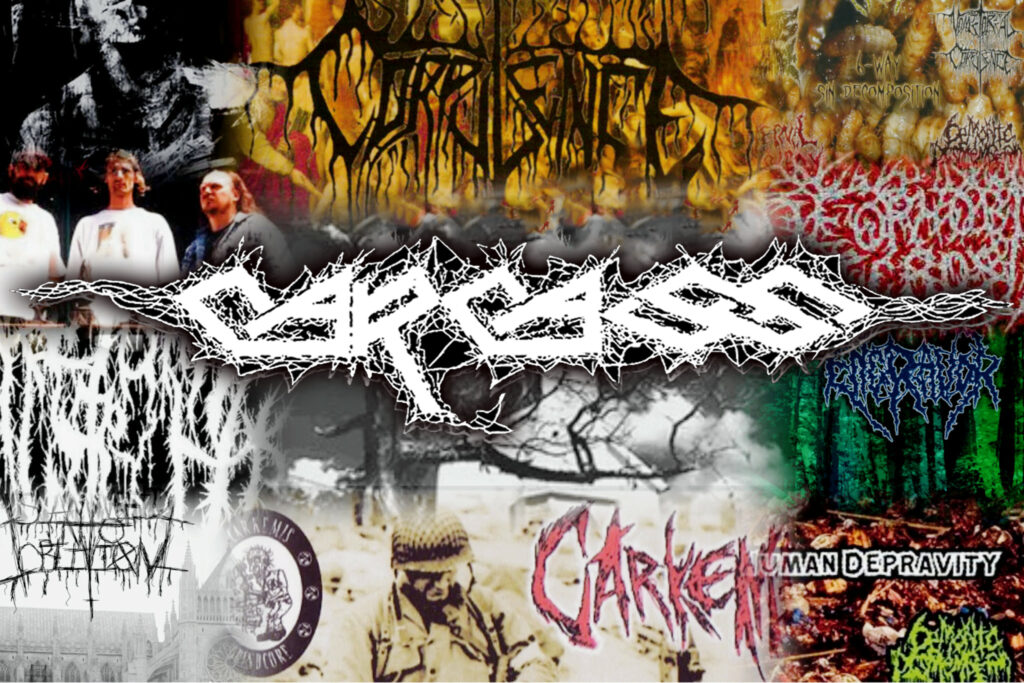
by Jason McLaren
*Disclaimer: The style of music covered in this overview, even if it falls under the Christian metal umbrella, is quite explicit in terms of lyrics and imagery. My coverage of this particular subgenre in no way implies I am in agreement with it all in terms of its lyrical content, aesthetics, or anything else. My goal is simply, as a music journalist, to document the phenomenon of Christian goregrind as a subgenre of metal and give a critical analysis of it.*
Well, somebody had to do it.
Few at the time would have probably thought Carcass’ debut album, Reek of Putrefaction, would end up spawning an entire niche style, goregrind, within an already pretty niche (and still quite new) subgenre of extreme metal known as grindcore. The unhinged gruesomeness of its lyrics (a mish-mash of hyper-technical medical terminology describing bodily decay and disease), unintelligible shrieks and pitch-shifted gurgles, and a botched production job that inadvertently gave birth to the “goregrind” sound would all contribute to the nigh-impossibility of the album ever reaching anything remotely resembling mainstream popularity. And yet, achieve it, it did (with famed radio DJ John Peel championing their sound along the way).
Like all styles of metal (well, maybe almost all), the Christian scene also had some bands take a major leap and explore the style as well. As per usual, it was a little late when it came to its own bands, but it’s entirely understandable when one considers the ridiculous extremity of the style and its corresponding aesthetic. If the still somewhat cautious Christian metal scene had been tendentious about releases by Saint, Mortification and Lament, I can’t even imagine how it would have viewed bands playing a goregrind style of music. I’m even pretty cautious with some of these artists.
Christian goregrind first saw the light of day with the release of Australian band Vomitorial Corpulence’s material on the compilation entitled The Extreme Truth – Australian Metal Compilation III in 1995. This material was released as a standalone record on cassette in 1995 as well on the memorably-titled Karrionic Hacktician, making for what I feel is the first release in the style for the Christian metal scene. With the longest song clocking in at a mere 1 minute and 24 seconds, Karrionic Hacktician featured 23 tracks of ludicrous-sounding grind that bordered on the ridiculous and the frightening all at the same time. It would be followed up in 1998 by what is arguably the defining classic of the style, Skin Stripper. To this day, Vomitorial Corpulence remains, at least to my mind, the archetypal band of Christian goregrind, and the definitive example of this kind of music.
Others, of course, would follow, and as with any style of music, some are far better than others. Flactorophia, a solo project from Ecuador spearheaded by Jose Barragan (who would tragically perish in 2008 in an accidental fire at a gig), became to be a cult favourite with its lone release, Redemption of the Flesh. A strange record that is absurdly short in length, Redemption of the Flesh featured a hyperactive drum machine and vocals that sounded more like an upset stomach than anything resembling conventional growls. Broc Toney’s main grindcore project, Eternal Mystery, became a prolific band and featured drum machines, simplistic processed guitars, and squelchy vocals. Poland’s No Return to My Vomit, a side-project of Fire of Elgibbor fame, would up the ante in terms of heaviness, but they would ultimately prove to be short-lived. Deophobic Necrosis, with their album Persecution, reimagined the album covers of Carcass’ Reek of Putrefaction and Symphonies of Sickness – instead of stomach-turning images of decay and rot, Deophobic Necrosis did up a collage of images related to persecuted Christians around the world (a heartbreaking and tragic thing to see). Other bands would give their own takes on the style, from the terrifying roars of Demonic Dismemberment to the almost unlistenable noise of Reconstructed Carcass, to more recent acts like Slammed Into Oblivion.
The major compilation associated with the style is one entitled Six-Way Sin Decomposition, a supremely underground grind split that featured Eternal Mystery, Vomitorial Corpulence, Engravor, Flactorophia, Demonic Dismemberment, and Vomitous Discharge (another major driving force in this style of music) all on one gigantic 82 track record. Some Christian goregrind acts (such as Flactorophia, for example) would appear on splits with other non-Christian goregrind bands, and I’ve always had very mixed feelings on this. Keeping the genre we’re talking about in mind here, it’s one thing to be an alternative Christian option on a split with secular bands, but it’s another to appear on records with bands whose lyrics and artwork revel in violence, gore and brutality simply to shock and horrify. It’s something that has never sat well with me personally, anyway, but I don’t know the underlying intent of the artists who have done this. Perhaps it’s evangelistic zeal at all costs, maybe they didn’t care. I don’t know.
So, after all that – you’re probably wondering how on earth Christians can play a style like goregrind in the first place. It’s more than a fair question.
In terms of the sound, Christian goregrind sounded pretty much par for the course. Pitch-shifted, inhuman vocals, and instrumentation concerned more with causing ear-related trauma than anything musical. Vomitorial Corpulence fits in nicely next to early Carcass, without a doubt. However, a great many Christian goregrind bands boasted a tinny, drum machine-driven sound and vocals that sounded less frightening than they did almost humorously ridiculous.
Aesthetically, some bands replaced the gory imagery of their secular counterparts with images of martyrdom and suffering (think of the cover depicting suffering Christians on Deophobic Necrosis’ Persecution, or the martyrdom of St. Bartholomew the Apostle on the cover of Vomitorial Corpulence’s Skin Stripper). Others eschewed gory imagery almost altogether; witness, for example, the simple photograph of a country church on the cover of Flactorophia’s Redemption of the Flesh or the more war-focused imagery of Eternal Mystery.
Okay, so far, so good I suppose. But I do have a criticism of sorts.
The problem I have with some of Christian goregrind is that I feel some of these bands took what Carcass had done and adopted the musical style to a greater or lesser extent, but missed the point of what Carcass may have been trying to point out on some level in terms of their ideas and lyrics. My criticism goes for pretty much any of the Carcass-clones in the secular metal world as well. Carcass’ first and second albums were and are shocking, somehow even still by today’s standards where it seems that nothing is shocking anymore. The real images of dead bodies pasted together into a sickening collage stripped away any remaining element of fantasy from some of metal’s more lyrically violent bands, and was frighteningly real. The images, and the lyrics, were obviously meant to shock. But they didn’t stop simply at being gruesome and disgusting – there was something of a point to it all in a sense and, I think, something for the Christian to latch on to as well when talking about this kind of music with other non-Christian metal fans. In a video interview from what must be around 1989 or 1990, Ken Owens (former drummer for Carcass), explained more of what the band was getting at. He noted that “Unfortunately, the world is in such turmoil, um, death has become entertainment” and noted that, despite the gruesome imagery and lyrics, that they were “not, um, advocating violence or anything like that, we’re totally against violence” (see the interview for these quotes).
In essence, I think Carcass inadvertently held up the result of a nihilistic and strictly materialistic view of life for all to see. If there is no transcendent meaning, no God, no concept of being made in the image and likeness of God, nothing of the sort; well, we really are just big hunks of meat, no different from any other living thing on earth (as Ken Owen notes in the interview linked to above, Carcass was attempting to show that there was no difference between animals and humans when it came to death and decay), and subject to corruption without hope. Death simply becomes a process of rotting, and little else; there is no bodily resurrection of the dead, no soul, no heaven or hell. Simply decay.
This paradigm, however, opens the door for discussion and conversation, and I wish that many Christian goregrind bands had picked up on this more. It’s one thing to emulate the sound, but it’s another to really do something with the lyrics, to use the themes of goregrind to somehow provide, perhaps, a response to the nihilism of the genre’s secular messaging. Instead, I think some Christian goregrind bands simply went for lyrics all about gory violence against demons and the devil, as if they were describing Antidemon album covers. In my view, this mostly came off as a quick way to “Christianize” the style, but lacked the depth behind what I think Carcass may have been trying to bring light to. To be sure, not all bands were or are like this. Vomitorial Corpulence’s lyrics often presented gore and rotting as a metaphor for sin and the wages thereof (cf. Romans 6:23). Deophobic Necrosis used their lyrics to bring attention to the suffering of persecuted Christians in other parts of the world. I think that’s why these bands stand out. But it would be awesome to see these bands engage more with the philosophy behind what Carcass was, perhaps, trying to express.
Regardless, it’s the understatement of the century to say that this is a style of music that is definitely not for everybody. It’s off-putting in almost every way, both sonically, lyrically and often visually, but it hasn’t stopped some artists from adopting the sound and repurposing the lyrical themes to some form of Christian use. It didn’t always work. But as a piece of niche Christian metal history, it’s a sign that even a subgenre that one would think could never possibly be played by Christian musicians isn’t necessarily off-limits.
Watch the full Carcass interview below:
About Author
