


Feature: Artificial Intelligence, Authenticity, and the Future of Music Creation
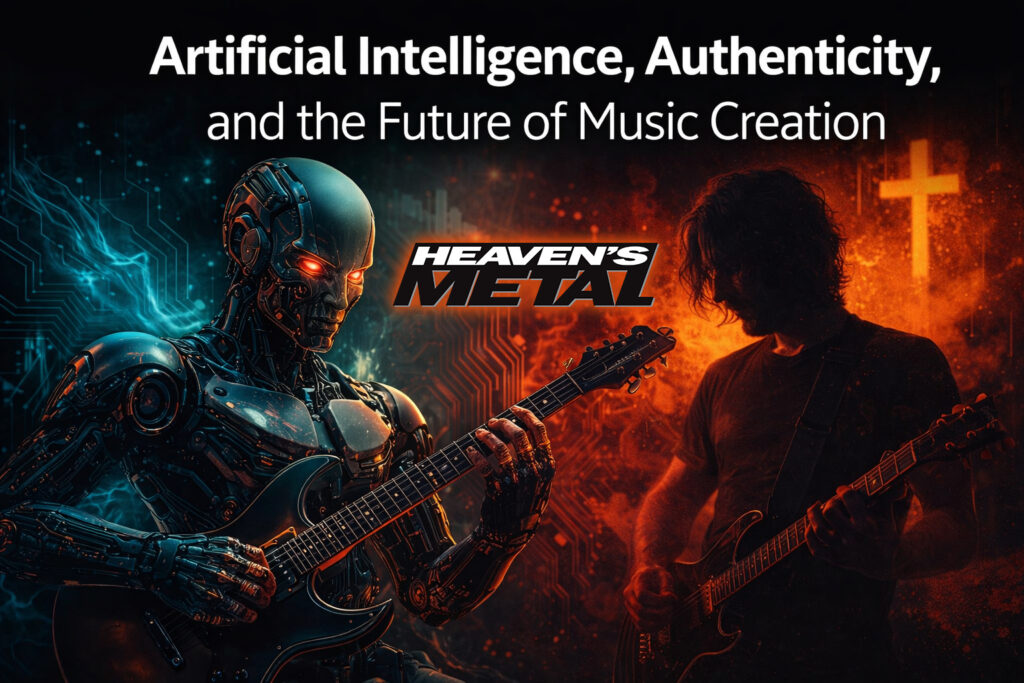
Artificial intelligence has rapidly entered the creative world, including music. What once seemed like science fiction is now a daily reality. Entire songs can be generated in minutes through prompts, complete with vocals, instrumentation, and artwork. For some creators, AI represents a new tool in the evolving landscape of music production. For others, it represents a fundamental threat to the integrity of art itself.
The debate has become especially intense within Christian music communities, where creativity is often connected to testimony, worship, and the stewardship of God-given gifts. Musicians, producers, label owners, and writers across the Christian metal and rock scene have begun asking difficult questions. Where does technology help creativity, and where does it replace it? What responsibility do artists have toward honesty and authenticity? And how should Christian creatives approach AI moving forward?
To explore these questions, several artists and industry voices shared their perspectives.
What Is AI in Music Creation?
When asked how artificial intelligence should be defined in the context of music creation, André Chiang of the band Shamash emphasized that the real concern lies in how the technology is used.
Artificial intelligence in music creation can be understood in several ways, but the most concerning application is when music is generated entirely through prompts without any reliance on human musicianship, skill development, or artistic discipline. Traditional creative tools—such as instruments, recording software, or production equipment—serve to enhance or capture human creativity. They are extensions of the artist’s mind, emotion, and experience. AI, when used to generate complete songs independently, fundamentally shifts that dynamic by replacing human creativity rather than supporting it.
This distinction is critical because music has historically been an expression of human struggle, practice, discipline, and emotional authenticity. When a piece of music is generated purely through prompting, it bypasses the years of dedication typically required to develop musical proficiency. This risks misrepresenting what art truly is and diminishes the meaning and value of creative labor. In its most extreme form, AI-generated music may create the illusion of artistry while removing the very human elements that define artistic authenticity.
Seth Metoyer, owner of Broken Curfew Records, writer for Metal Crawlspace, Assistant Editor for Heaven’s Metal Magazine, and member of the bands Mangled Carpenter, Pulpit Vomit, and Brain Matter, highlights a key difference between traditional tools and AI systems.
“A guitar, a DAW, or a sampler responds to human decisions. AI can initiate material on its own. It doesn’t imagine, struggle, or intend—it predicts through learning. That distinction matters, especially when we start talking about authorship and meaning.”
Metoyer believes the issue is not simply whether AI is used, but who ultimately remains responsible for the creative decisions.
“If AI is assisting a human vision, helping with workflow, exploration, or refinement, then the human is still the author. The line is crossed when AI replaces human decision-making entirely.”
Angelo Torquetto, of the band Torquetto, shares a similar perspective.
“I believe every tool has its place—from analog gear to digital studios. Yet, the artist must always remain the driving force. True creation stems from the intellect and emotion; it is how artists turn lived situations into sound.”
For Torquetto, the concern is not technology itself but what happens when the act of playing disappears.
“The problem with AI is that while it executes based on your prompts, it removes the act of playing.”
Oversaturation and the Flood of Content
One of the most immediate impacts of AI music is the sheer volume of content now appearing online.
Metoyer believes the biggest problem is not corruption but confusion.
“The biggest impact I see right now is oversaturation and confusion, not corruption. We’re being flooded with content (and for the record, I’m not a fan of the cookie cutter AI generated garbage that’s flooding the industry), much of it created quickly through a prompt and without thought or reflection, and that makes it harder for listeners to discern what carries real intention behind it.”
He believes the issue becomes even more significant in Christian music communities.
“In faith-based communities, the issue becomes more serious. Christian music isn’t just about sound,it’s often tied to testimony, worship, and lived experience. When AI-generated music is presented without clarity, it blurs the line between genuine expression and automated output, which can weaken trust.”
Torquetto also sees the effects showing up in everyday digital life.
“I believe society is already feeling the impact. For instance, when I look for quality music or videos for my kids on YouTube, I’m bombarded with AI-generated junk. It’s frustrating because these creators know children lack a sophisticated filter, so they exploit that fragility for profit. Making money is fine, but come on—at least put in the effort to create something authentic.”
The Question of Musicianship
For many artists, the issue ultimately comes down to what it means to be a musician.
Hilton Lazenby of Reborn United and Afflicted Truth believes the difference between human creativity and AI generation is fundamental.
“There’s a huge difference when it comes to writing music with musical instruments, Having the creative mind and knowing exactly what you want in a song, AI can never do that, it’s inferior to the recording tools that are out there, AI will never have that true sound.”
He is particularly critical of projects that generate entire albums through AI.
“My thoughts on artists using AI to create 100% of the music can’t call themselves musicians, if they can’t play an instrument, it’s never too late to learn, go learn how to play an instrument and get to the level where you can go into a studio and record. Then you’ll see how much hard work it is, stop being lazy.”
Chiang also believes AI-generated bands create a false narrative about artistry.
Creates a false narrative that a prompt engineer is an artist. This is demeaning to actual musicians. Producing real music requires immense time, skill, cost, and effort — all of which are being trivialized by AI-generated “band” posts that level the playing field unfairly.
He adds that AI content can drown out real artists.
AI posts flood feeds and overshadow hardworking bands who need engagement and sales to recover their production costs.
Authenticity and the Role of the Artist
A recurring theme throughout the discussion is the concept of authorship.
Metoyer explains that authorship is not simply about influence, but about responsibility.
“AI crosses into authorship when the human role is reduced to pressing ‘generate’ and publishing the result. Authorship isn’t about influence, it’s about responsibility for meaning. Editing, curating, rejecting, reshaping, those are human acts that preserve authorship. Music needs to communicate something. Someone needs to be accountable for what’s being said, especially in Christian contexts where music is often tied to belief, conviction, and witness.”
He also believes misrepresentation is one of the biggest ethical concerns.
“Experimentation itself doesn’t bother me. What concerns me is misrepresentation. If something is entirely AI-generated but presented as a band, with implied human instrumentation, experience, struggle, or testimony, that’s deceptive branding. Listeners deserve to know what they’re engaging with. Transparency doesn’t weaken art; deception does.”
Chiang agrees that transparency is essential.
Releasing AI-generated music without disclosure is ethically problematic because it constitutes a form of misrepresentation. Audiences often engage with music under the assumption that it reflects human creativity, emotional investment, and lived experience. When AI-generated content is presented as human-created without transparency, it violates the trust between artist and listener.
Lazenby takes a similar stance.
“I think that if an AI generated song is released, the person that released it should disclosure that it’s fake and AI generated.”
Creativity, Faith, and Responsibility
The conversation also raises deeper questions about creativity itself, particularly in Christian music communities.
Chiang explains that AI-generated music may undermine spiritual authenticity.
AI-generated music, while potentially aesthetically pleasing, lacks genuine spiritual experience and intentional devotion. Worship music often resonates with listeners because it reflects the authentic spiritual struggles and victories of its creators. Without that personal dimension, AI-generated music may struggle to convey the same depth of meaning or relational connection. For many believers, authenticity in worship is inseparable from human testimony and personal faith expression.
Metoyer offers a nuanced perspective.
“I believe everything ultimately exists as an extension of God’s creation, including technology, and AI is no exception. Because of that, I don’t think AI is inherently incapable of having value in testimony or worship.”
However, he still emphasizes the importance of intention.
“That said, the source still matters. Testimony and worship have to come from the heart and intent of the person creating the work, not from plug-and-play prompts designed to churn out a quick worship album.”
He also believes Christian communities should approach the topic carefully.
“The responsibility isn’t to police or panic; it’s to model integrity and discernment. There is a tremendous amount of misinformation surrounding AI right now, along with a lot of rage bait and fear-based narratives.”
Instead, he encourages thoughtful conversation.
“Christian communities, in particular, have a responsibility to slow the conversation down and help people understand what AI actually is and what it isn’t.”
A Real-World Warning
The concerns surrounding AI-generated music are no longer theoretical.
A recent federal case in the United States demonstrated how AI music can be exploited. A North Carolina man was charged after allegedly using artificial intelligence to generate hundreds of thousands of songs, uploading them to streaming platforms, and then using automated systems to inflate the play counts. The activity reportedly generated more than ten million dollars in fraudulent royalties that should have gone to legitimate artists.
Federal authorities charged him with wire fraud, conspiracy to commit wire fraud, and money laundering conspiracy.
A Warning from a Veteran
Even established musicians have spoken about the risks.
Michael Sweet of Stryper recently addressed the issue directly.
“But yeah, the whole AI thing and letting AI do your albums? Kids, don’t do that! Don’t. Please don’t do that. That’s it. Keep the creative juices flowing and the originality that comes from the human touch—your touch versus a computer’s touch.”
Looking Forward
Despite the controversy, most artists agree on one key point: technology itself is not the enemy.
The challenge moving forward is maintaining integrity while navigating new tools.
Metoyer summarizes the issue simply.
“The real question isn’t whether modern tools were used, but whether the artist is being honest, intentional, and accountable for the work they’re putting into the world.”
Chiang offers a similar perspective.
Technology will continue evolving, but moral principles remain constant. Christian creatives may benefit from approaching technology with discernment, ensuring that creative output remains truthful, transparent, and spiritually sincere.
In the end, the debate surrounding artificial intelligence and music creation is not just about technology. It is about authenticity, stewardship, and the role of human creativity.
And for many artists, that creativity remains one of the most powerful gifts God has given.
About Author
