


Interview: Mangled Carpenter Discuss Chaos, Faith, and ‘The Absence of Light’

There’s something fascinating about Mangled Carpenter’s trajectory. They’ve never chased trends, yet each release feels like a new mutation. Their sound keeps morphing into something heavier, rawer, and more emotionally seared. From their demo First Offering, recorded in 2005 (in what they call “The MySpace Days”), to 2021’s Under The Shadow, and 2023’s Salvation Syndrome, they’ve carved a niche in the underground extreme metal scene with a mix of deathgrind chaos, spiritual unrest, and lyrics that resist easy resolution.
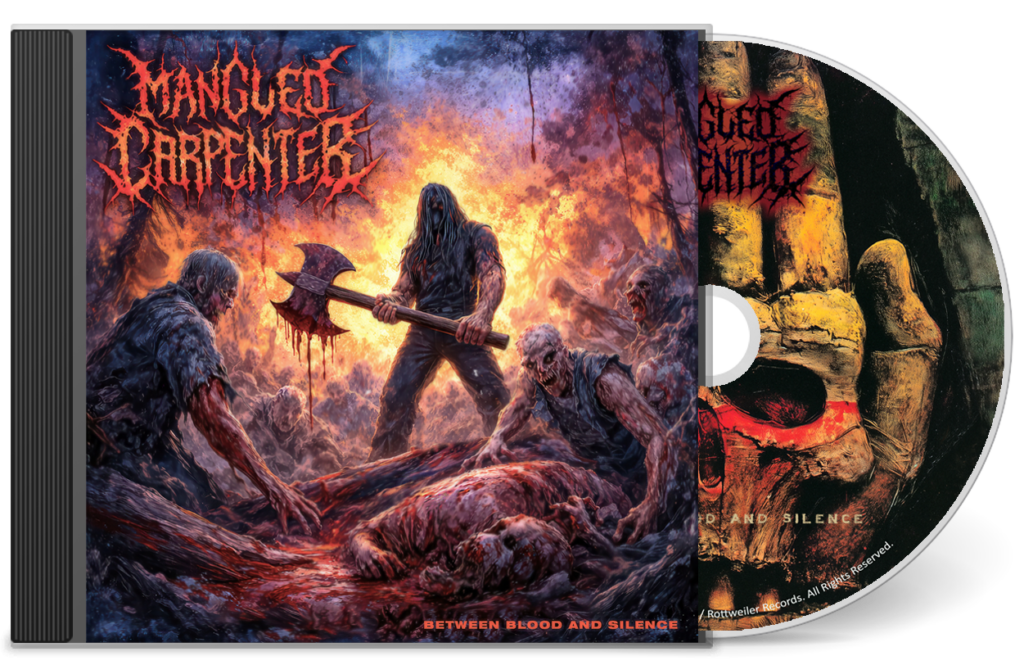
(Order the CD of Between Blood and Silence here).
Salvation Syndrome introduced the band’s most streamed track to date, “Lumberyard,” which tackles Matthew 7:3–5, while “Spit Parade,” featuring Jason Wisdom of Becoming the Archetype, became one of the project’s most talked-about songs. Its violent meditation on Christ’s march to Golgotha feels like standing ankle-deep in dust and blood outside the city gates while the crowd screamed for execution.
The band is back with its third release, Between Blood and Silence, an upcoming EP dropping in July 2026 as a joint effort between Broken Curfew Records and Rottweiler Records, pushing the boundaries of brutality even further. The first single, “The Absence of Light,” already sparked conversation across the underground scene. Musically, the track leans harder into deathcore territory while still retaining the suffocating grind and hyper-aggressive extremity that listeners often compare to Cattle Decapitation. The shift is intentional, with riffs that stagger and crumble like machinery ripping itself to pieces.
Lyrically, the new material opens a different door. Earlier Mangled Carpenter releases centered heavily on biblical theology and scriptural imagery. “The Absence of Light” drags the focus into modern society, institutional corruption, collective decay, and the darker architecture of human behavior itself. The result feels less like a sermon and more like staring into a cracked mirror.
The second and final single arrives Friday, June 5, with Heaven’s Metal premiering the exclusive first announcement. The track reimagines “Terminate Damnation” by Mortification, one of the defining anthems in Christian death metal history from one of the genre’s foundational bands. Watch the official Mangled Carpenter Facebook page closely, as the cover artwork reveal follows soon.
With that, we step into the chaos, philosophy, noise, and history behind Mangled Carpenter in this new interview with Seth Metoyer (guitars/vocals) and Kris Olson (bass/backing vocals).
Chris Gatto: Is Mangled Carpenter your longest running band?
Kris Olson: Yes, Mangled Carpenter is definitely our longest-running music project. Our first demo, ‘First Offering,’ was released back in 2005 during what we call the “MySpace era.” That was really the beginning of Mangled Carpenter as people know it today. Even though it’s not on MySpace anymore, those songs are still floating around online if you know where to look. We actually have one of the posts pinned on our Facebook page where people can stream the demo and even download the songs for free!
CG: What started Mangled Carpenter for you?
KO: What started Mangled Carpenter for Seth and me was this idea of creating some of the heaviest music possible, the kind of music we would have absolutely loved growing up. We were always drawn toward the more extreme side of heavy music. Bands like Vengeance had a huge impact on us, especially their release Human Sacrifice. That record really fueled our love for heavier music. And of course, Mortification was massively influential too, especially their debut album and Scrolls of the Megilloth. Back then, they were gaining attention alongside bands in the Florida death metal scene like Deicide, Obituary, and Cannibal Corpse. We loved that extreme style of music and realized there was this whole subculture of people who loved it too, and we were definitely part of that world.
At the time, we knew a lot of musicians, but most of them weren’t actively playing in bands. This was during the years Seth and I were living in Redondo Beach through Sanctuary, “The Rock and Roll Refuge.” I was serving as an assistant administrator to Pastor Bob at what people called the Sanctuary House, while Seth and I lived at the “Beach House” with a bunch of other guys from Sanctuary Church. Naturally, all of us were heavily into metal music. During that season, we actually got to meet many of our musical heroes, bands like Tourniquet, Precious Death, Deliverance, and Vengeance. I still remember a conversation I had with Roger Martinez when he came into the Sanctuary office and introduced me to Carcass. I had never heard them before, and I was blown away. They’re still an incredible band to this day.
One of our roommates during that time was a guy named Neal Christmas, who was also really into death metal. Neal had a four-track recorder and a drum machine/synthesizer setup, and he would create music completely on his own, guitars, vocals, drums, everything. Watching him do that really stuck with us. Here was this guy making extreme music without needing a full band or expensive studio setup. A few years later, Neal took those ideas and formed a death metal project called Persecuted, which people can still find on YouTube today.
That whole experience planted seeds for what would eventually become Mangled Carpenter. Years later, around 2005, Seth and I finally sat down and started building songs ourselves using a drum program called Double Bass Mania. We used it to create the drums for our first demo. We’d piece together beats, rearrange sections, and build songs layer by layer. Back then we were using Sony Acid Pro, and maybe even FL Studio, to import the drums and record bass, guitars, and vocals. Seth was using his death metal guitar pedal, and we even experimented with using some of those effects for distorted vocals alongside my DigiTech interface.
So really, Mangled Carpenter was born out of years of inspiration, community, experimentation, and a shared love for extreme music. From those early influences in the ’90s to finally recording our first demo in the early 2000s, it all slowly came together into what became Mangled Carpenter.
CG: The band name influence is obvious, but which came first — the music or the band name?
KO: The influence behind the band name is probably pretty obvious, but the funny thing is, the name actually came before the music. Seth and I have a long history of coming up with band names and ideas together. A lot of people don’t realize Seth and I are twin brothers. He’s used the name Seth Metoyer as a pseudonym in the entertainment industry for over twenty years now. Growing up we shared a bedroom, so we spent a ton of time hanging out, listening to music, drawing, painting, and being creative together. We were constantly coming up with imaginary band names and logos that we thought sounded cool for heavy bands. Names like Eternal Injection, Anti-Natas, which was “anti-Satan” spelled backward, and of course, Mangled Carpenter. Mangled Carpenter
At the time, we were heavily influenced by the underground metal scene, so we’d sketch out logos and designs that fit that extreme metal aesthetic. One day we decided to actually send some of those band names to the band Haven, because we were huge fans of their album Your Dying Day. They actually wrote us back! Of all the names we sent them, they said they liked “Mangled Carpenter” the best. That really stuck with us. What started as a creative idea between two brothers and validated by the band members of Haven, eventually became something real years later.
When we eventually moved out to Redondo Beach, California, I ended up designing the original Mangled Carpenter death metal logo by hand before heading out to the beach one night. That became our first official logo for the band. We’ve updated and refined it over the years, but that original design was where it all began. So in the end, the band name and logo came first, followed by the music.

CG: You (Seth) play with your brother Kris, but you are on opposite coasts. Have you ever played a live show together?
Seth Metoyer: No, but, back in the day, we played a lot of air guitar gigs together. My neck still hurts from all the headbanging. For writing these days, we hop on Zoom to exchange ideas, and he eventually sends me his finished tracks, which I mix in using Cubase, my go-to DAW.
CG: Drumming is such an important part of extreme metal. Why no drummer?
KO: Honestly, there are a few reasons for that. First, it’s incredibly hard to find a drummer who can actually play extreme metal at the level we’d need. When you’re talking about 220+ BPM, blast beats, and double kick patterns, that takes a very specific skill set and years of practice. Not every drummer can step into that world comfortably.
Another major factor is time and logistics. Seth and I live on opposite sides of the United States now, so even coordinating recording sessions between the two of us can be challenging at times. Adding another person into the mix for rehearsals, writing, and studio work would make things even more complicated and expensive. At the end of the day, our main goal has always been simple: create the kind of heavy music we would’ve loved growing up, the kind of music that pushes boundaries and sounds massive.
That’s where programming came into play for us. Years ago, we discovered Double Bass Mania, and that really helped us start bringing the style of music we heard in our heads to life. Now we use EZdrummer 3, which has become a huge part of our writing process. The cool thing about it is that you can take the drum patterns you’re imagining, whether it’s an intro, chorus, bridge, or breakdown, and actually build them out in the program. Seth and I usually start by constructing the drum ideas first, often with input from our other brother, Tim Olson, a.k.a. Mac Hine; much like how hip-hop artists build beats before adding other music and vox. After that, I lay down the bass, Seth records guitars, and then we start developing lyrics and vocals as the song evolves. Sometimes the lyrics even shift depending on how the rhythms and vocal phrasing develop naturally during the process.
What’s interesting is that this approach really isn’t uncommon anymore. A fun fact a lot of people may not know is that Michael Sweet from Stryper talked publicly about using EZdrummer 3 to write the drum parts for an upcoming Stryper record because it saved a tremendous amount of time. He already had the structure and feel of the songs in his head, and the software allowed him to flesh those ideas out quickly before bringing them to the studio. The difference is that Stryper has Robert Sweet, who could then come in afterward and perform the live drum parts in the studio.
So really, it comes down to practicality: time, money, distance, and workflow. Using programmed drums allows us to create the music we hear in our heads without limitations, while still keeping the intensity and precision that extreme metal demands.
CG: Is it hard to find musicians in this extreme style of music?
SM: Yes, I think it is for many extreme metal bands, especially underground Christian metal bands.
CG: “The Absence of the Light” seems to introduce a much deeper subject than first blush would suggest. You are challenging our perception of evil as an institution rather than being personal. What prompted this shift for you?
KO: What really makes art interesting, especially music and lyrics, is that it’s open to interpretation. We all want to know what a song means or what an album cover represents, but over the years I’ve realized that sometimes the meaning people pull from art can become even more personal than what the artist originally intended. I’ve had songs hit me deeply in a certain way, only to later find out the artist meant something completely different. Same with visual art. That personal connection is important. So while we’re not trying to be intentionally obscure, we are doing something a little different with this release, both musically and lyrically.
Musically, Mangled Carpenter has always lived somewhere between death metal and grindcore, two styles Seth and I love. We’ve always leaned into that extreme side of heavy music. But with this EP, we started experimenting more with deathcore elements too. Seth is handling the deep growls and low vocals, while I’m doing what I call the “squeals,” the higher-pitched vocals. So just like the music evolved a bit, the lyrics became more poetic and layered too, which means people will probably interpret them in different ways.
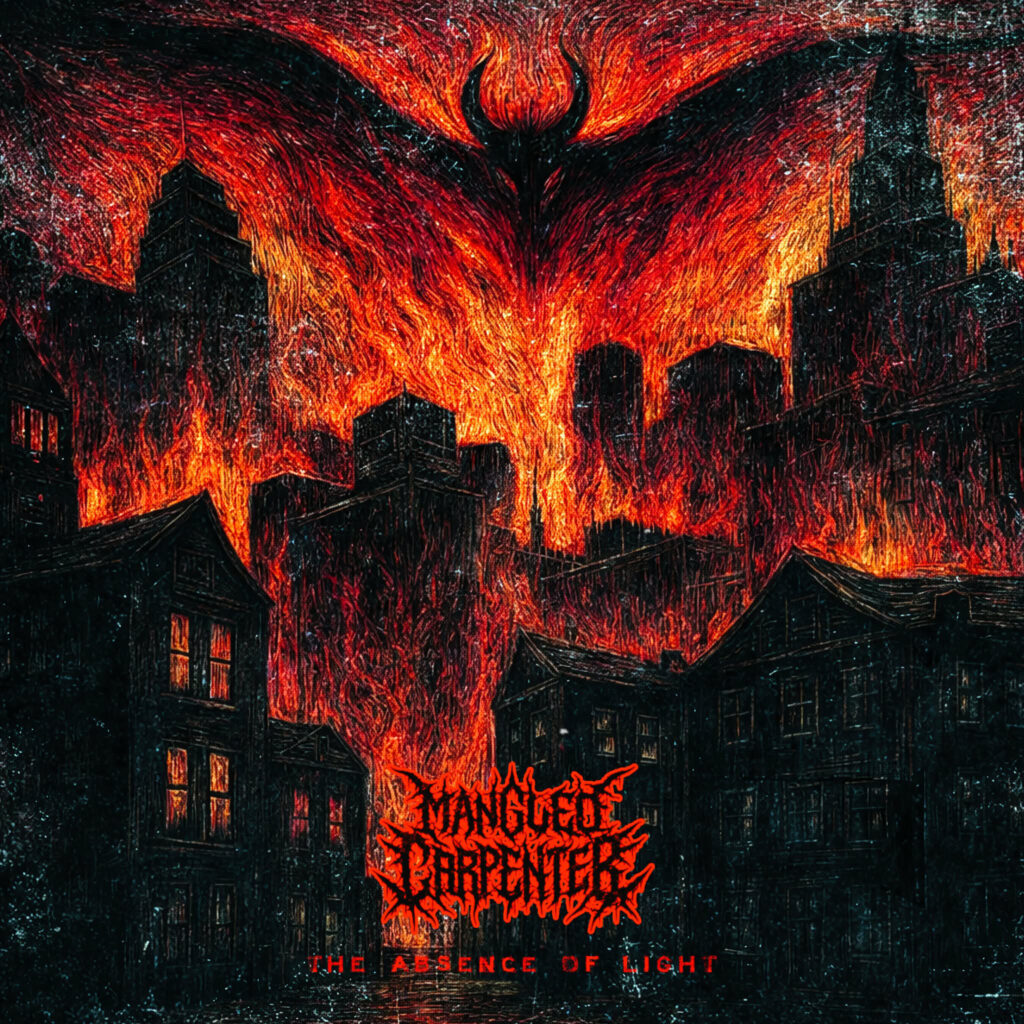
For me personally, “The Absence of Light” is about exposing the lie of separation. I believe there are really two worldviews people live from: connection or separation. Separation is fear-driven. It creates an us-versus-them mentality. It operates from scarcity, the idea that there’s not enough, so we have to protect ourselves, our tribe, our denomination, or our side. That mindset has fueled empires throughout history. It breeds division, suspicion, fear, and self-preservation. But Jesus introduced something completely different: The Kingdom, which is rooted in connection, abundance, and love. The antidote to fear is love.
The song really wrestles with how fear distorts perception. When we live from a fear-based mindset, we start looking for enemies “out there” while ignoring what’s happening inside us. Sometimes we even dress fear up and call it discernment, but if it only produces more division and separation, we should probably stop and examine it. Scripture says perfect love casts out fear, and I think that’s important. Darkness often begins internally long before we project it outward onto systems, institutions, or other people.
At its core, the song is a call to confession, to truth-telling. Confession simply means telling the truth. It’s about allowing God to renew our minds and choosing connection over separation. Jesus told us to love our neighbors because the Kingdom has never been about self-preservation. It’s about others. Real freedom doesn’t come from obsessing over external enemies or blaming systems. It comes from allowing the light of God to expose and heal what’s going on inside us. Love is the solution. Connection is the solution. The Kingdom is the solution, not fear, hatred, or empire thinking.
That’s what “The Absence of Light” means to me. It’s about exposing darkness by bringing things into the light.
Seth and I want to create music that actually adds value to people. Through Broken Curfew Records, Seth and I hear a lot of bands and a lot of music, but what stands out to us is when something carries substance and says something meaningful. So if you’re into extreme music that blends death metal, grindcore, and some deathcore influence, we’d love for you to check the song out. We think you’ll really dig it.
CG: Is seeing evil as a conspiracy wiping away the blame and shame of our personal actions?
SM: I actually think the song argues the opposite. The focus isn’t that evil exists as some hidden conspiracy that removes personal responsibility from us. The song pushes against that mindset.
A lot of people want evil to exist somewhere in separation from them. They want to point at Hollywood, politicians, secret societies, corporations, governments, or whatever the villain of the week happens to be. Conspiracy culture can become spiritually comforting because it externalizes the problem. It lets people imagine evil as something committed by ‘those people’ while avoiding the harder reality that darkness runs through every human heart, including our own.
Having worked in Hollywood and around the entertainment industry for over 25 years, my experience has seen far less coordinated ideological machine and far more people trying to tell stories, build careers, survive creatively, or make money. The pursuit of money itself can absolutely become corrupting, but that’s different from this idea that there’s a unified secret agenda controlling humanity from a dark room somewhere.
Most indie filmmakers I know aren’t trying to brainwash culture. Most of them know they probably won’t even make their money back. They’re trying to express something personal, spiritual, emotional, philosophical, or artistic. The Horror genre especially creates space for people to wrestle with spiritual questions in ways other genres often avoid. Some of the most spiritually reflective films I’ve seen came out of horror.
So when ‘The Absence of Light’ talks about corruption or darkness, it’s really pointing inward before it points outward. The song deals with humanity’s tendency to project evil onto systems, conspiracies, or enemies while ignoring the rot inside ourselves. That’s the real danger. Once people convince themselves evil only belongs to ‘them,’ they stop interrogating their own pride, greed, cruelty, lust for power, tribalism, or self-righteousness.
The song isn’t saying, ‘Look at the conspiracy.’ It’s saying, ‘Look in the mirror first’.
CG: The song reminds me of the black stain that would appear over the heart of characters in Frank Peretti’s “The Oath.” This is the sin that gnaws away at the hearts of men. Was Peretti an influence for you on this one?
SM: I don’t think Frank Peretti was a conscious influence while we were actively writing the song, but I’m sure those ideas seeped into my thinking over the years. I was a huge fan of both This Present Darkness and The Oath when they released, and I’ve reread them multiple times since then. Those books leave a mark on your imagination, especially when you grow up immersed in that blend of spiritual warfare, horror, and theology.
Looking back now, I can absolutely see the connection, especially with The Oath. That image of the black stain spreading over the human heart always stuck with me because it represented something deeper than surface-level evil. Peretti framed sin almost like a living infection, something people feed through denial, compromise, fear, and hidden corruption. That atmosphere definitely lines up with the emotional DNA of ‘The Absence of Light.’
The song isn’t really about cartoon demons jumping out of the shadows. It’s about what happens when darkness becomes normalized. When people adapt to spiritual decay so completely that they stop recognizing it as decay at all. That idea probably owes as much to the movies Se7en, Jacob’s Ladder, and They Live as it does Peretti. Those stories all have this suffocating sense that corruption slowly seeps into culture, institutions, belief systems, and the human heart until people begin mistaking the darkness for normal life itself.
Peretti preached through horror fiction. ‘The Absence of Light’ probably lives more in the ruins after the sermon already failed.
The Absence of Light (lyrics)
A city of letters
built on hearsay.
Every window lit,
no one home.
They swear there is a hand
behind the curtain,
but the curtain moves
only when fear breathes.
Names dissolve
when held too tightly.
Meaning fractures
under interrogation.
They demand confession
from metaphors,
strap symbols to the chair,
ask them who sent them.
The symbols remain silent.
They were never witnesses.
A map with no landmarks.
A war declared
against reflections.
The skyline
It casts down infection.
The hills blamed
for what the valley imagines.
Saints were once wounds,
not trophies.
Ash and hunger,
not glass and gold.
Now they are mirrors
no one wants to look into,
so they are turned into statues
and blamed for breathing.
Horror knows what sermons forget:
that God is not polite.
That terror is sometimes
the only language left
when certainty rots.
Between blood and silence,
questions survive. All.
They build theology
out of silhouettes,
call the absence of light
a conspiracy.
But fog is not an enemy.
It is what happens
when no one waits for dawn.
Discernment moves slowly,
like water through stone.
Paranoia runs,
shouting directions
it never checked.
One listens.
The other points.
There is no machine.
Only hands shaking
in the dark,
mistaking echoes
for orders.
God does not hide
in the rafters of fear.
But fear will gladly preach
in His name
until silence interrupts it.
Between blood and silence,
questions survive. All.
They build theology
out of silhouettes,
call the absence of light
a conspiracy.
But fog is not an enemy.
It is what happens
when no one waits for dawn.
About Author
