


Feature: When ‘Rock’ Isn’t Enough – Why the Dove Awards Need a ‘Metal’ Category
Demon Hunter, a band that has spent two decades combining epic breakdowns fueled by double-kick drums, distortion, and powerful lyrics tied to images of blood atonement, shares its category with artists who seldomly drift farther than an amplified guitar.
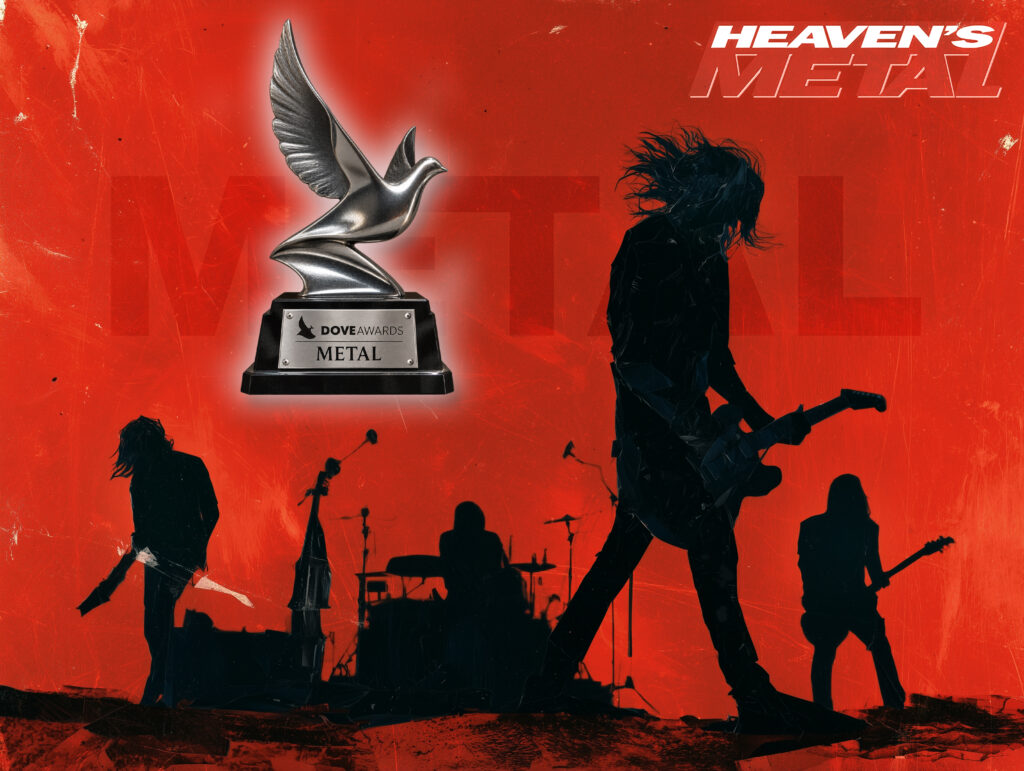
The recently announced 57th Annual Gospel Music Association’s Dove Awards nominee list is full of top tier Christian music. However, the fine print contains a quiet absurdity. Demon Hunter, a band that has spent two decades combining epic breakdowns fueled by double-kick drums, distortion, and powerful lyrics tied to images of blood atonement, shares its category with artists who seldomly drift farther than an amplified guitar.
Demon Hunter‘s fifth GMA Dove nomination for the 57th annual awards came for their album There Was A Light Here, placed in the “Rock/Contemporary Album of the Year” category. Meanwhile Brandon Lake, this year’s most-nominated artist and the reigning face of arena worship, picked up a nod in the parallel “Rock/Contemporary Recorded Song” category.
Lake‘s nominations span song of the year, rock/contemporary recorded song of the year, pop/contemporary album of the year, and country/roots recorded song of the year. One artist writes riffs built on drop-tuned distortion, blast-beat percussion, and lyrics that sit with lament longer than most Sunday setlists allow. The other writes worship anthems built for raised hands and stadium screens. The GMA has filed them under the same word, and it isn’t the first time. Demon Hunter has absorbed this same category collision across five separate nomination cycles stretching back to 2008.
Similarly, Stephen Stanley’s heavy, synth-blended “idols” is nominated for “Rock/Contemporary Recorded Song of the year” alongside Brandon Lake’s cinematic-worship anthem “SEVENS”, Josiah Queen’s acoustic-folk-rock “Dusty Bibles”, and gritty indie-rock worship artist Strings & Heart’s “eyes on him.” The sound and musical differences between these artists’ work is so wide that putting them on the same playlist feels like a prank.
It’s time for a change. It’s time for a new awards category: metal. Adding this category wouldn’t divide the industry; it would finally give heavier Christian music the platform it has earned while still honoring the softer styles that have shaped the mainstream. This isn’t a radical idea and the genre’s growth makes the idea more relevant now than ever.
Christian metal is no longer a fringe curiosity tolerated at the edge of the industry. It has generational depth. Kids who grew up on Underoath, Zao, Norma Jean, and For Today now raise their own children on Demon Hunter, Wolves at the Gate, Bloodlines and Convictions. The genre has over 40 years of documented evolution, from the early days of Stryper and REX Records to the metalcore explosion of the 2000s.
Heavier Christian music has its own infrastructure of festivals, labels, and international touring circuits that operate almost entirely outside the traditional Christian music industry’s gravitational field. They are often built by fans who never expected mainstream recognition and stopped waiting for it years ago. Popular music festivals, like Furnace Fest and Loud & Proud Festival, are tailored events specifically for heavy Christian acts. Some festivals, like Uprise Fest, include a “Rock ‘n Roll” stage to accommodate the growing demand.
Christian metal and hard rock artists have also produced a library of theologically dense songs and albums that wrestle with doubt, suffering, abuse, mental health, and sanctification with a unique realism and seriousness that worship radio, engineered for repeatability rather than complexity, rarely attempts.
None of that musical maturity registers in a nominee list that treats “rock” as a catch-all drawer for anything with an electric guitar in the mix.
The category collapse isn’t just an inconvenience. It’s an error. The error is distortion is not an aesthetic garnish. It is a structural component of heavy music, built to carry dissonance and weight that clean tone cannot hold. It changes what a chord is capable of communicating — the same three notes read as comfort through a clean channel and as confrontation through a wall of gain. Add double-kick drumming and breakdown architecture, artists can organize a song around tension and release in ways foreign to the four-on-the-floor pulse of a worship set designed for congregational singing. A worship song is engineered for accessibility; singable range, predictable chord movement, lyrics that a room of strangers can join by the second chorus, because the point of the form is corporate participation. A metal record is often engineered for something different. Metal resists easy consumption. It makes the listener sit inside discomfort before any revelation arrives, if it arrives at all.
Marcus Moberg describes Christian metal as an uncommon fusion mixing evangelical Christianity with an aggressive, highly controversial popular music form. Moberg’s broader argument, developed across his history of the scene’s evolution from its early-1980s formative years to its current international reach, is that Christian metal has always defined itself in explicit contrast to the rest of contemporary Christian music, refusing to grind down metal’s aesthetic edges. That refusal is the point. The sharp edges are not a liability to be blunted into a broader “rock” bucket for convenience.
There’s something to be said for an awards body resisting the temptation to multiply categories into oblivion — nobody wants forty-five hyper-specific trophies nobody remembers by spring. Christian metal did not need the Dove Awards to prove itself for the last four decades, and it will not need them going forward either.
Still, categories exist for a reason. James K. A. Smith’s account of worship as formation argues that our liturgies, sacred or secular, train our loves toward a particular vision of the good life long before we consciously assent to any doctrine. A worship set and a metal set are both liturgies in that sense. They are simply forming different affections through different means — one through corporate ascent and resolution, the other frequently through confrontation with the unresolved. Collapsing them into a single award category doesn’t just mismeasure musicianship; it flattens two distinct formational practices into one, as though the difference between them were cosmetic rather than substantive.
Christian metal has spent forty years building a scene, a theology, and a sound that stand on its own terms. It has earned an award category (several, probably) that reflect what the music actually is, rather than what fits conveniently on a broadcast.
Bibliography
Billboard. “Phil Wickham, Brandon Lake, CeCe Winans Lead 57th Annual GMA Dove Awards Nominees: Exclusive.” July 29, 2026. https://www.billboard.com/music/awards/phil-wickham-cece-winans-lead-gma-dove-awards-nominees-1236304947/.
Moberg, Marcus. Christian Metal: History, Ideology, Scene. London: Bloomsbury Academic, 2015.
RadioU. “Demon Hunter Receives Fifth Nomination for GMA Dove Awards.” July 31, 2026. https://radiou.com/musicnews/demon-hunter-receives-fifth-nomination-for-gma-dove-awards/.
About Author
