Review: Glory of Kings – Roots of the Past
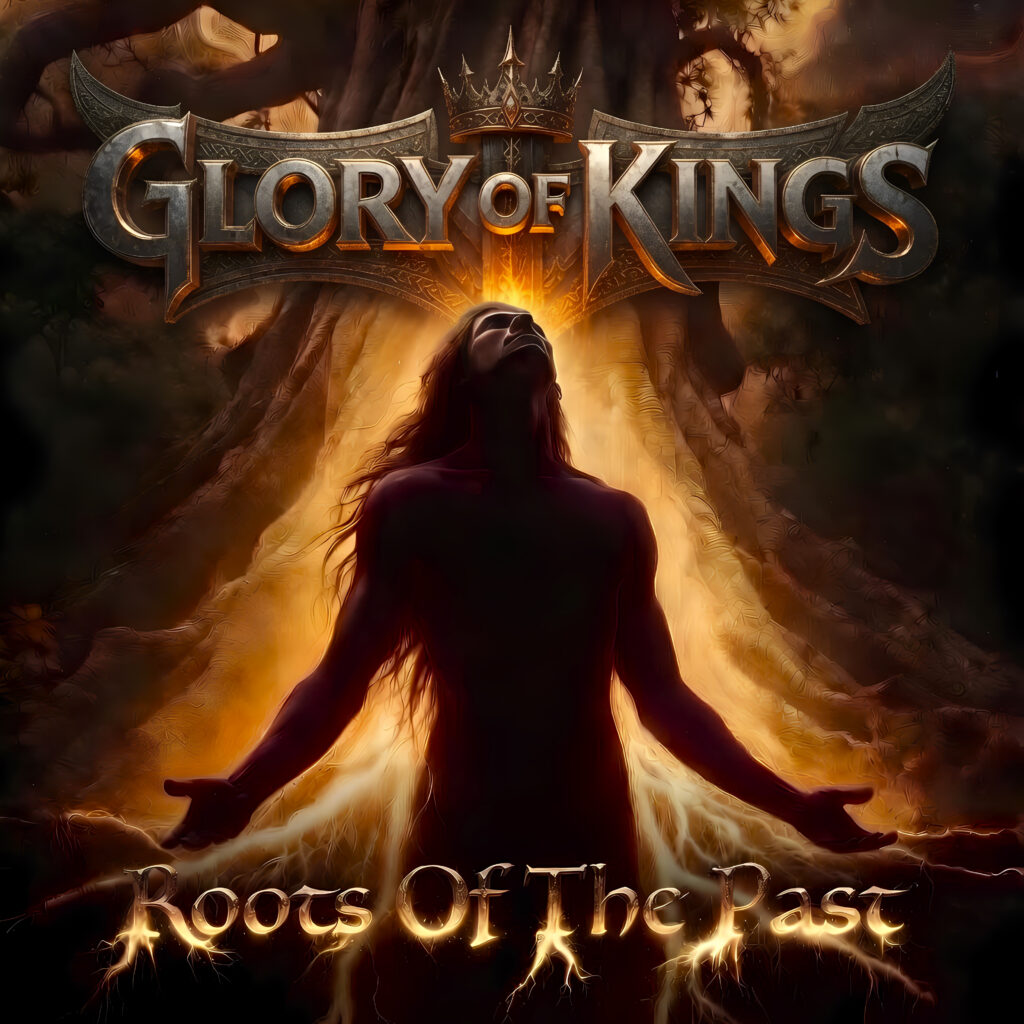
Without trying to be blasphemous or pun-frantic, this album starts off gloriously. An epic, mood-inducing keyboard and chanting vocals a police siren here, motion noises there, it builds into a crescendo with movie score and then “Mindwar” comes kicking out of the speaker with twin guitars, rapid drumming and four Red Bulls vocals that speed with aggression. It sounds like a metal band in full attack mode. This track introduces the band in full color. I hear vocals like Jimmy Brown (Camelot in Smithereens era) or Geoff Tate.
Fans of Queensryche, Sacred Warrior, Deliverance, Iron Maiden, and Dream Theater have a smorgasbord of smart, tasteful, and progressive riffing to feast upon. The playing is tight, starts and stops on a dime, and the songs have dynamics that calm the beast inside (super melodic) and then stir up trouble again. I’m immediately in love with the drum tones, guitar lines, and most importantly – the vocals.
Lyrically, the songs are bold yet tell stories. Like the great Destroyer of Death album from 2024, the lyrics are not shy about the biblical worldview they were crafted inside. It’s a great listen on headphones and like releases from yesterdecade, the songs stand strong on their own but are best experienced by a sit-down album listening.
Having whet your appetite and promoting the salivating response from prog and symphonic metal lovers, I’ll turn over the rest of this review to the Professor – Peter Emerson.
As I do with my part of the podcast The Critic & the Professor, I like to put on my music theory hat, listen for harmonic structure, form, texture, tones, and anything else that stands out to me as being unique. For me, music is the most interesting when it sets up an expectation but delivers a twist. Glory of Kings Roots of the Past delivers a few of those moments worth noting.
I appreciate little details like the fact that the opening song, “Gathering Storm,” is more of a brief, cinematic overture that sonically transitions into the first full song, “Mindwar,” in the same key area. That might seem like a small thing but to me it suggests that the band is being mindful of creating a cohesive musical narrative across the album. “Mindwar” launches into a high energy introduction punctuated by driving double bass drums, and a really tasty guitar theme that makes appearances throughout the track. They let us know very early that they mean business.
As a composer, and a keyboard player, I’m always interested when I hear synth parts, string parts and the like. Yet I find it curious when they are used but the band does not list a dedicated keyboard player as a member of the band. “The Mystery” is a great example of a song that has dynamic range. It is not in your face all the time, starts with string synths, and features a really beautiful solo guitar tone. The keyboards really add to the overall sound even though they are not the feature.
Another moment on the album that really shows range is the song “Foreshadows.” Employing an eastern sound with a sitar and pads (once again synths) playing lines drawn from the Spanish Phrygian scale that gives it that Egyptian feel, the song is a slow build much like Ravel’s Bolero and reaches its peak with a shredding guitar solo.
There are a few moments on the album that leave me with questions. The track “Gods and Men” has a very distinct vocal that evokes a technique of constant, or parallel motion where the lead and the harmony part move by the same interval. This creates dissonance between the vocal parts and the music bed beneath it. I’d like to ask them if this was intentional, and if so, “why?” Separately, the vocal seems interesting, as does the music bed when taken on its own merits. Yet, when heard together it just didn’t sit well for me. I can safely say that “Gods and Men” is my least favorite track on an otherwise really compelling album.
Though not as blatant as on “Gods and Men,” there seems to be a little bit of disconnect between the vocal harmony and the band on the final track of the album, “The Waiting Game.”
By far my favorite track on the album has to be the title song “Roots of the Past.” For me, this song shows the most musicality between a wide dynamic range, interesting textural changes, and definite prog leanings. Once again, very effective use of keyboard sections including piano. I’d love to hear more of that from them in the future. But, if there is a track on the album that I could see enjoying serious commercial success, it would be Roots of the Past.
My overall impression of the album is that the band is very talented, and good in the studio. Though the songs have a legitimate Prog feel to them, they don’t venture into Prog song length. All of the songs stay within or close to radio playlength. The songs feel like they belong together. In other words, there is a sonic cohesion to the album that I appreciate. The positives overall outweigh the questions I have about vocal harmony choices. And, I think the song “Roots of the Past” is worth the price of the entire album. I will look forward to hearing future releases from Glory of Kings. And, if they ever decide to lean even further into the use of keys, I know a guy.
About Author