


Michael Sweet, Billy Corgan and the Stryper That Never Existed
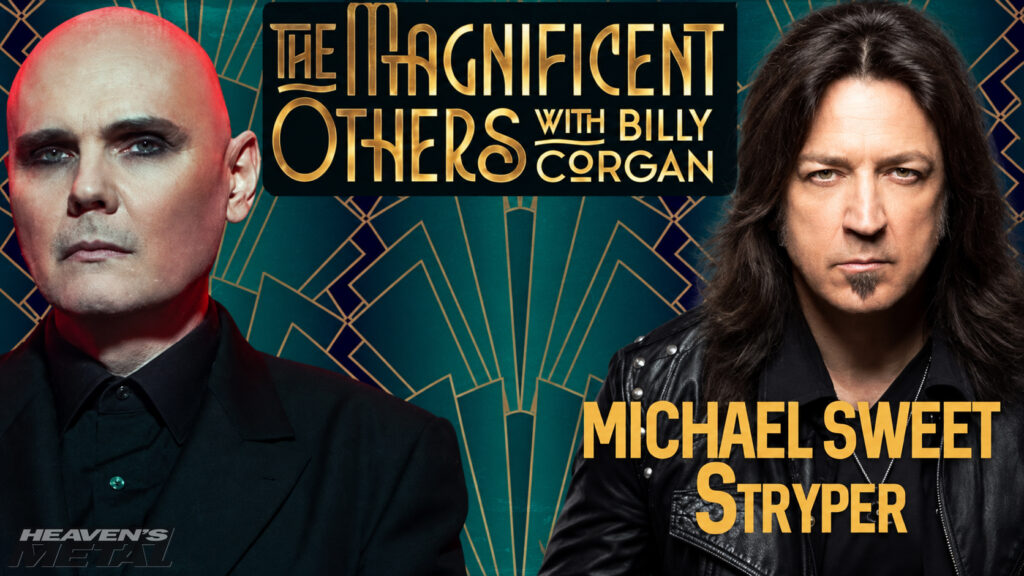
Original image: The Magnificent Others with Billy Corgan / YouTube. Heaven’s Metal editorial graphic.
By Seth Metoyer | Heaven’s Metal Magazine
There is an alternate universe somewhere in which Michael Sweet never rewrote those lyrics.
Maybe the band stays Roxx Regime. Maybe they pick another name, preferably something that looks good airbrushed across the back of a denim jacket. They still have the guitars and the harmonies. Robert Sweet still hits the drums like somebody owes him money. Michael still possesses that absurd upper register that makes ordinary men reconsider whatever noise they have been calling singing. Oz Fox is still Oz Fox. The Sunset Strip is still crawling with hairspray, ambition, cocaine, record-company guys pretending they know which one of these bands will matter in five years, and enough Aqua Net to alter the atmospheric composition of Southern California.
Everything stays basically the same.
Except Jesus.
Billy Corgan brings up this imaginary world during his September 23 conversation with Sweet on The Magnificent Others, and once he does, I can’t stop thinking about it.
Sweet has apparently considered the possibility himself. Had Stryper never sung about Christ, he says, perhaps they would have become even bigger. Corgan takes the thought one step further and produces the proverbial time machine: knowing everything Sweet knows now, would he go back and change it?
Sweet says no.
Of course he says no.
Anyone who has followed Michael Sweet for more than ten minutes probably knows the answer before Corgan finishes asking the question. This is a guy who eventually describes himself during the interview as having “tunnel vision.” He picks a road and walks down it. Sometimes everybody follows. Sometimes people throw rocks. Occasionally Christians stand outside the venue protesting him while he is inside singing about Jesus.
Rock and roll is a strange business.
I understand Sweet’s theory about the secular version of Stryper. I personally suspect the time machine might produce an outcome different from the one he imagines.
My hot take? Stryper may have become huge because they sang about Jesus.
The Strange Guys in Yellow and Black
Start with the obvious. Stryper were good. Really good.
Remove every Bible, every reference to Isaiah, every Christian bookstore controversy and every theological argument that has accumulated around the band over four decades, and you still have musicians who could hang with the era’s heavyweights. Michael Sweet could sing his tail off. The guitars were muscular and melodic. The harmonies carried traces of Queen, Boston and Journey into a metal band that also adored Judas Priest, Van Halen and Iron Maiden. The rhythm section hit with the appropriate amount of 1980s violence. They understood hooks.
Corgan realizes this immediately because he was there, watching from Chicago while the rumors traveled.
He remembers hearing about a new band around 1985. They were apparently really metal. They were apparently really good. They wore stripes. And they were really into God. That final detail is the thing. Imagine somebody describing Poison in 1986. Great hair. Catchy songs. Women love them. Party band. Mötley Crüe? Dangerous guys. Motorcycles. Drugs. Nikki Sixx might die before the encore.
Stryper required a longer explanation.
They looked like someone had weaponized a Pittsburgh Steelers uniform. They played legitimate metal. The singer could peel paint from the ceiling. They threw Bibles into the audience. Yes, Bibles. At a heavy metal concert. And somehow the whole ridiculous thing worked.
In the 1980s, Los Angeles overflowed with talented hard-rock bands. Every club had a new act, every telephone pole was buried under thousands of flyers, and every rehearsal room housed four guys certain they were just months away from taking Van Halen’s place. Stryper gave people something they had to talk about.
Then the Stripes Became Scripture
The funniest part of Stryper’s carefully recognizable visual theology is that it apparently wasn’t carefully recognizable visual theology at all. Sweet explains that the yellow and black came first. During the Roxx Regime days, the band already had stripes. They looked cool. That was essentially the theological foundation. Then Christianity entered the picture again.
Once the band became Stryper, Isaiah 53:5 supplied the connection: “by His stripes we are healed.” Suddenly the aesthetic had meaning. The costume became symbolism. Something born in the grand tradition of rock musicians asking, “Does this look cool?” acquired biblical significance after the fact. If somebody wrote that into a screenplay, a producer would probably tell them it was a little too convenient. Yet there it is.
This is also why I have trouble with the idea that a secular Stryper automatically becomes bigger. Take away Christianity and you still have an excellent band. You also remove one of the most recognizable collisions of image, message and music to emerge from that entire scene.
Yellow and black looked cool. Yellow and black attached to Isaiah 53:5 became Stryper. Those are different things.
Heavy Metal Was Fine With Hell
Corgan keeps returning to another question throughout the conversation, and it is one I’ve wondered about myself.
Why did God freak everybody out?
Heavy metal has always enjoyed playing with forbidden imagery. Satan could wander freely through the genre carrying a sword and riding a dragon while flames shot out of somebody’s Marshall stack. Death, demons, occultism, sexual depravity, murder, war, apocalypse — welcome aboard. There was probably room on the tour bus.
Jesus apparently required a meeting with management.
Corgan remembers listening to Slayer and Stryper. This never struck him as particularly difficult. You could own both records. Nobody exploded. I think that’s the key. I knew Christians who loved Stryper and others who despised them, believing they were masking “evil” with Christianity. I also knew non-Christians who thought they were dope, tearing their pictures out of Hit Parader and hanging them alongside posters of Poison and Slayer.
Yet Stryper’s faith did become a dividing line for others. Sweet understood exactly what they risked when the band committed to it. During the interview, he recalls a friend visiting their studio after becoming a Christian and telling them that if they gave the band to God, extraordinary things could happen. Sweet went away and started rewriting lyrics. By the next morning, he had essentially made the decision.
They were doing this. No coded spirituality. No vague references to “the light” that could mean Jesus, personal enlightenment or a particularly nice sunset depending on which radio station was interviewing them.
Jesus. They knew the decision could destroy their chances of getting signed. It didn’t.
Which must have been deeply inconvenient for everybody who thought it would.
Nobody Likes Being Preached At
Here is where I think the popular caricature of Stryper gets lazy.
They sang explicitly Christian lyrics, absolutely. Early Stryper also preached more directly from the stage than Sweet says they do today. Yet the emotional center of the band’s best-known message rarely sounded like an angry guy with a sandwich board informing passersby that God hates them.
The message was remarkably simple.
You are loved. There is hope. God gives a damn about you. That resonates with people.
And yes, I know how sentimental that sounds written on a screen in 2026. Put it through distorted guitars, a ridiculous drum sound and Michael Sweet screaming it several octaves above where most human beings keep their voices, and suddenly sentimentality acquires teeth.
Sweet has also changed his approach with age.
He tells Corgan that Stryper once operated much more like an extension of the church culture around them. They preached between songs. They talked to people after shows. Evangelizing formed an explicit part of the mission.
Today he says something I find considerably more interesting. “The music does the talking.”
Sweet has watched aggressive evangelism push people away. He doesn’t want to do that. The lyrics already tell you where Stryper stands. If somebody wants to hear it, there it is. If they don’t, Sweet seems perfectly capable of surviving the disappointment.
There is a kind of wisdom that arrives only after spending forty years watching human beings argue about God. Eventually you realize nobody has ever been bullied into transcendence.
Then the Christians Showed Up
Naturally, the secular music world wasn’t the only place where Stryper caused trouble. Christians had problems with them too. This is one of those delightful ironies that makes the history of Christian rock considerably more entertaining than its critics realize.
Sweet remembers Christian retailers refusing to carry To Hell with the Devil because the cover contained a pentagram. The artwork depicted angels defeating Satan and ripping the pentagram away from him, which one might think would satisfy the doctrinal requirements of a Christian bookstore.
Apparently the pentagram itself ended the conversation. See symbol. Panic. Ask questions never.
Then there were protests.
Sweet recalls people connected with Jimmy Swaggart protesting Stryper concerts. The band responded by going outside and offering the protesters tickets.
Come inside. Watch us. Then tell us why we are evil.
They declined.
I love this story because it captures something Christianity has always struggled with when confronting culture: sometimes people become so vigilant about guarding the gates that they forget to look at what is actually happening on the other side.
Stryper spent years getting side-eye from metal fans for being too Christian while portions of Christianity regarded them as suspiciously metal.
That should have been exhausting. It also gave them one a niche.
The Time Machine Problem
Which brings us back to Billy Corgan’s machine.
Sweet believes Stryper might have become bigger without the Jesus thing. He was there. He watched doors close. He knows the conversations we never heard and the opportunities that disappeared before anybody announced them publicly. I take his assessment seriously.
I also think history contains a cruel little paradox.
The thing that keeps you out of one room can be the thing that fills another. Christianity cost Stryper listeners. I have little doubt about that. Some metal fans heard “Jesus band” and stopped listening immediately. Christianity also made them impossible to confuse with anybody else.
Imagine taking To Hell with the Devil and removing everything that makes the title strange. Give it a conventional metal title. Change the artwork. Replace the Christian lyrics with another collection of songs about sex, partying, rebellion and broken hearts.
You probably still have a strong record. You also have another record competing with hundreds of records about sex, partying, rebellion and broken hearts. Stryper wandered onto MTV talking about salvation. People remembered.
Corgan himself becomes Exhibit A. Four decades later, he still recalls the weird rumor traveling through Chicago: great band, stripes, Jesus. That is branding money can’t buy.
Make Better Music
Sweet also spends part of the interview doing something I have always appreciated about him: annoying his own side.
Corgan raises Sweet’s previous criticism of Christian music, particularly the idea that Christian artists simply need to make better music. Sweet reiterates his frustration with how interchangeable portions of modern worship music can become. Strip away the lyric and one production begins sounding suspiciously like the next.
Corgan jokes that if everybody sounds like Coldplay, the problem is that we already have Coldplay.
Fair point.
This might actually explain Stryper’s longevity better than any talk about Christian-market demographics. They had the songs. The theology gave them a unique identity, and the musicianship kept that identity from feeling like a gimmick.
There is a version of Stryper that could have existed purely as novelty: look at the crazy Christian metal guys throwing Bibles around. That version disappears after two albums.
The actual band kept making records because Michael Sweet could write melodies, the band could play, and eventually musicians from supposedly more respectable corners of metal began quietly admitting to Sweet that they loved Stryper.
Sweet tells Corgan that this still happens. Guys pull him aside and confess their fandom almost conspiratorially, like they are admitting to an affair.
I hope that never stops.
There is something wonderfully absurd about grown metal musicians whispering, “Hey man, I love Stryper,” as though someone from Deicide might be hiding behind the curtains.
Faith After the Fireworks
The conversation gets more interesting when Corgan moves beyond Christian-rock history and starts asking Sweet what he actually believes after everything he has lived through.
Sweet’s answers lack the polished certainty that often makes religious celebrity interviews unbearable.
He has experienced loss. His first wife, Kyle, died from cancer. Sweet talks about anger, grief and eventually rebuilding a life. He doesn’t manufacture supernatural stories to make the journey prettier. When Corgan asks about dramatic spiritual experiences, Sweet readily admits that some of the manifestations other Christians describe simply haven’t been part of his experience.
He believes because of what he sees when he looks backward across his own life. That strikes me as considerably more interesting than somebody claiming God rearranged a cloud formation on command. Faith becomes more complicated once everybody gets older. Bodies fail. People die. Careers stall. Children grow up. Friends disappear. Certainties that sounded excellent at twenty become considerably harder to carry at sixty.
Sweet is still carrying his. That alone tells you something.
Keep Making the Record
Near the end of the interview, Sweet talks about his own cancer. Doctors removed part of his thyroid previously, and cancer now exists on the remaining side. He describes it as small and slow-growing, and his medical team continues monitoring it, but its proximity to the vocal nerve presents an obvious danger if surgery eventually becomes necessary.
For most people, vocal-nerve damage would qualify as terrifying. For Michael Sweet, whose voice has paid the bills, carried the message and split the air above Stryper songs for more than forty years, the prospect feels almost perversely specific. So naturally he wants to record three albums.
Sweet tells Corgan he doesn’t know whether he will still be able to sing in two years, so the instinct is to create while he can. That brings the entire conversation around in a strangely satisfying circle. At twenty, Michael Sweet rewrote some lyrics and committed his band to a path that could have destroyed their career.
Four decades later, confronted with the possibility that the instrument inside his own throat might someday fail him, his response remains essentially unchanged. Make the record. Do the thing. Deal with everything else afterward.
Leave the Time Machine Alone
So no, I don’t think I’d send Stryper through a time machine. Maybe Secular Stryper sells ten million records. Maybe they become one of the biggest bands of the decade. Maybe Michael Sweet spends 1989 sitting next to David Lee Roth at an awards show while someone from MTV calls them the future of American hard rock. Or maybe they just get lost in the shuffle—one of those bands that could have been great, but there were so many already that no one noticed them.
Four guys dressed like radioactive bumblebees walked into the middle of 1980s heavy metal, played as hard as the people around them, sang unapologetically about Jesus, irritated Christians and secular gatekeepers in roughly equal measure, sold millions of records and somehow survived long enough for Billy Corgan to invite Michael Sweet onto a podcast forty years later and ask what in the world happened.
After nearly eighty minutes, Sweet’s answer boiled down to something surprisingly simple: he chose a path and stuck with it. Maybe that was the secret.
About Author

Excellent article!
If any other band had released seven albums in a row that were of as consistently high a quality as the last seven Stryper albums have been*, they would be almost universally lauded as one of all-time greats.
[*I wasn’t counting the Christmas album.]