Feature: Aidan Mullen on Metallica, Cliff Burton, and Surviving the 1986 Bus Crash
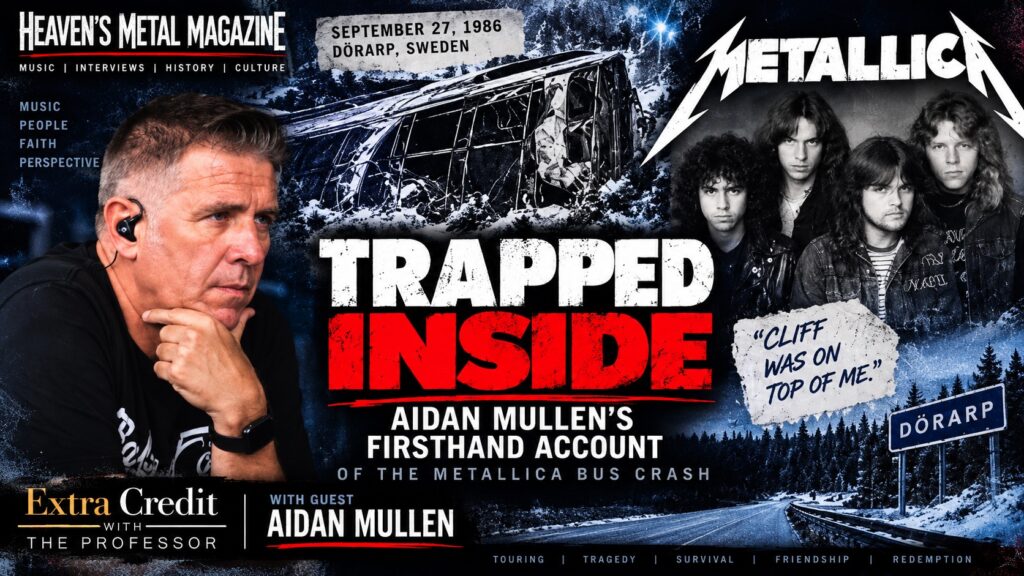
I first met Aidan Mullen through a conversation about his years working on the road with Def Leppard. What began as a look back at life behind the scenes with one of rock’s biggest bands quickly revealed that Aidan had another remarkable story to tell.
Before Def Leppard, Aidan worked as a guitar technician for Metallica during their 1986 tour with Ozzy Osbourne. On September 27, 1986, he was aboard Metallica’s tour bus when it crashed near Dörarp, Sweden, killing bassist Cliff Burton. Forty years later, Aidan sat down with me for Extra Credit with the Professor to recount what he experienced that night, the aftermath of the accident, and how those events affected the course of his life.
The video interview is embedded here, followed by our conversation in transcript form.
And Aidan’s story doesn’t end with Metallica. In a companion Extra Credit interview, we continue the conversation with his years working with Def Leppard and the remarkable journey that followed.
INTERVIEW TRANSCRIPT:
Interview transcript prepared for Heaven’s Metal Magazine. Intro to be
added by Peter B. Emerson.
Editorial check before publication
- At the point where rehearsals in Birmingham are mentioned, the source
rendered a word as “tourously.” The intended word is unclear and
has been marked in the transcript. - The transcript has been lightly edited for punctuation, capitalization,
obvious name corrections, and removal of repeated filler where it
impaired readability. Speaker wording and meaning have otherwise been
preserved.
Aidan: No one ever asked me about my personal experience. I know I
remember it vividly to this day. Some of the accounts certainly differ
from what I remember.
Peter: 40 years ago today on September 27th, 1986, Metallica’s tour
bus left the highway in southern Sweden. Cliff Burton was killed. Aidan
Mullen, then working as James Hetfield’s guitar technician, was trapped
beneath the overturned bus beside him and survived. In our previous
conversation, Aidan took us inside his years on the road with Def
Leppard. Today he shares his first-hand account of Metallica during the
Master of Puppets era, the accident that changed everything, and the
faith that carried him through what followed. Aidan, welcome back to
Extra Credit with the Professor.
Aidan: Thanks Peter. Happy to be back.
Peter: Thank you. So you spent part of the 1980s working with
Metallica, specifically as James Hetfield’s guitar tech during this
extraordinary period when the band was becoming something much bigger.
But I don’t really want this to be a Metallica history lesson. I want to
hear what that period looked like through your eyes because you were
actually there. So let’s go back to the beginning.
Aidan: Sure.
Peter: Okay. You’re a Bay Area guy. Metallica famously relocates from
Los Angeles to the Bay Area, largely because Cliff Burton didn’t want to
move south. I’ve wondered, had that move never happened, do you think you
would have ever ended up working for Metallica?
Aidan: You know, had they been based in the LA area full time, maybe
not.
Peter: Yeah. Would you have taken the gig if it had meant relocating
to LA?
Aidan: No.
Peter: Well, I guess there’s our answer then.
Aidan: Well, yeah. No, I would have considered it. And I suppose it
would have to, there would have been a lot of factors involved. But in
this instance, no, I don’t think it made a difference one way or the
other. I think it was more of a timing thing, just being introduced at
the right time.
Peter: Tell us how you actually did get the job with James Hetfield
as his guitar tech.
Aidan: So I was working with another Bay Area band called Y&T. They
were quite popular at the time. I had moved back in with my folks for a
short period of time in Northern California. And one day, my dad comes in
and says, there’s a fella named Bobby Schneider on the phone to talk to
you. So I went in and I spoke to this guy and he got my name and my
number from another Y&T employee, my friend Adam Day, who went on to work
with Slash, with Guns N’ Roses and Neal Schon, with Journey for years.
They had called him and asked him if he would come work for them. And he
declined, but he gave them my information. He was on salary with Y&T. I
was not. I was paid by the show. And I was honestly looking for something
a little bit more stable. So Bobby and I had a conversation. It went
well. And then the next day, he called me back and put James on the
phone. And James and I had a conversation. And in all honesty, the heavy
metal scene was not my scene. Y&T was about as heavy as it got for me.
And I had recalled in the back of my head that I had actually seen
Metallica at one point. And it was at a Day on the Green show in Oakland,
California, back the summer before, with Scorpions and some others. And I
remember vividly thinking, what’s with the noise? I heard this racket.
And so I had to walk down to the stage to see what was going on. And my
first impression was a bunch of guys, hair flipping around, and music
that I absolutely did not understand. But James and I hit it off on the
phone. We had a good conversation. And they offered me the job. I got on
a plane, went to meet them.
Peter: So this was right in the meat of their summer.
Aidan: Yeah. And this was in the middle of the tour that they were
supporting Ozzy Osbourne on. By the time I arrived out there, James had
notoriously fallen skateboarding and had broken his wrist, his arm. And
by the time I got out there, he was in a cast and couldn’t play guitar.
So John Marshall at the time was Kirk Hammett’s guitar tech. John is also
a prolific player and definitely understands the heavy metal genre way
better than I do.
Peter: Went on to record four albums with Metal Church.
Aidan: Metal Church, yes. Absolutely. Absolutely.
Peter: And ultimately came back in ’92 and played for James again.
Aidan: Yep.
Peter: When he burned himself in the pyrotechnic incident in
Montreal.
Aidan: And oddly enough, there’s a little caveat there. So I actually
flew back out and did the remainder of that Guns N’ Roses tour with them
right after he got burned.
Peter: Oh, wow.
Aidan: And John Marshall was back to playing James’ parts.
Peter: It was pretty much 1986 all over again.
.
Aidan: Pretty much. Yeah. So yeah, I ended up working for Kirk
Hammett for a couple of weeks, a few weeks. And that went really well. We
got along very well. And it didn’t matter because I had no… What am I
looking for? I had no way to prep for the gig other than knowing that
there were going to be guitars with six strings on them and Mesa/Boogie
amps and Marshall amps and things. So it was a fresh start. So it didn’t
much matter. Kirk and I got along well. James eventually recovered. And
then we, you know, [they] started rehearsals in Birmingham, England after
he was given the all clear to go back to playing guitar. And that’s how
that transpired.
Peter: Wow. That is fascinating. What was your job doing the guitar
tech for James? I mean, what… Walk us through what that looks like.
Aidan: My job is to maintain the gear, the instruments, the amps, the
pedals, the cables, you know, anything hardware related to the gig,
making sure that the amplifiers don’t hum and squeal and stop working and
crackle and sputter. And the main part of the job is that if something
does go wrong, we’re immediately on it, if not sooner. You know, the show
must go on always. So if a guitar breaks, if a string breaks, if an
amplifier goes down, we have to be prepared. You’re only as good as your
spare.
Peter: When you first started with them, I mean, you’re jumping in,
they’re already going down that helter-skelter slide.
Aidan: Oh, yeah.
Peter: Did you already sense that something unusual was taking place
with this band that they were going to explode?
Aidan: So yes. And once I got over the initial one or two days of
complete utter culture shock for me, I realized walking into some of
these arenas, and again, in the support slot with Ozzy Osbourne, and Ozzy
was pretty big back then, I was starting to notice in some of these
arenas, you have the upper level, and these kids would paint banners,
draw these banners out. And I started noticing that there were more
Metallica banners than there were Ozzy banners. I was starting to notice
that the crowd reaction was far more rabid for Metallica than it was for
Ozzy. And hats off to Ozzy, he did a great show. Jake E. Lee was in the
band playing guitar with him at that point. Bark at the Moon was big at
that time. So it was a match made in heaven for the two bands, but I did
notice almost immediately that Metallica were, they were poised to just
do something extraordinary. And again, I can’t stress enough the fact
that that I didn’t at that time and still to this day really don’t, that
genre isn’t really my thing necessarily. Although I did finally after
years, I went and saw Metallica a year ago, maybe two years ago, summer,
we were, we were out touring, Leppard was out touring, and we had a day
off in Minneapolis. And James, James’s current tech invited a few of us
out. The production was extraordinary. Everybody was in good form. I saw
a lot of old friends ran into a few people that I didn’t know how they
were going to react to my presence there. And in every case, I got a hug
and a, Hey, man, it’s great to see you and that kind of thing. So they
went from that band that I started with in 1986 to this extraordinary
superhuman cream of the crop top of the hill kings of their genre.
Peter: And still there.
Aidan: And still there. And still there to this day.
Peter: Yes. So you’re working directly with the band, really, really
tough schedule. And, and this is, this is still summer 1986. Were you
able to form any relationships with any of the guys? Did you get to know
any of them on a personal level?
Aidan: The band guys. Oh, yeah. Oh, yeah. Yeah, yeah. Yeah, we were
all, it was back in the day when I actually preferred it back then. We
were all in it together. We all traveled on the same tour bus together.
We stayed in the same hotels together. You know, I, I was so I was oddly
enough, I was the Bay Area guy at that point. So I was the guy that Lars
would call it one o’clock in the morning when he needed help with
something. I was, you know, James and I went to a rodeo together one day.
It was fantastic. Went fishing together. I think we had a good friendly
relationship. And it carried on, you know, as, as a band gets bigger,
there’s a certain separation that happens.
Peter: So the organization added layers, in other words.
Aidan: Yes. Yeah. And, and, you know, when you’re, when you’re an up
and coming band, you can get away with having a stage manager that maybe
doubles as a production manager or a production manager that doubles as a
tour manager or, you know, in my case, a guitar tech that doubles as a
stage manager.
Peter: Yeah.
Aidan: As the shows get bigger, the ticket prices get higher. The,
the venues get bigger. The schedule gets crazier, more and more travel.
And the status becomes grander. All of a sudden now they’re staying in
high-end hotels. And in a way, it’s disappointing to see that separation
become larger and larger. But it’s also understandable.
Peter: Yeah.
Aidan: You know, when they, when they get that big, there’s all kinds
of other responsibilities. There’s a lot of press that is required. And a
lot of it they don’t like doing, you know, when, when the guys get to the
venue, James always had a hug for me at the beginning of the show every
night. You know, and, and I haven’t spoken to him in a long time. And I
actually, I wouldn’t mind at some point having a conversation with him
again, because I know that we left on, on terms that weren’t ideal.
Peter: And, you know, I hope you get that opportunity.
Aidan: That would be, that would be great.
Peter: Yeah. Who would, who would you say you were closest with?
Aidan: With the band?
Peter: At that point in the band.
Aidan: Yeah. You know, I would say James for sure. And, and Kirk, a
very close second. Again, he and I always got on great with same similar
musical tastes and things as well.
Peter: But, but you know, tell me about Cliff back in that, in that
timeframe when you first got in the band, did you have much interaction
with Cliff?
Aidan: Well, the thing, the thing with Cliff that was the hardest for
me is that no, I didn’t really have much interaction with him. One of the
ironic situations where I was forced to have interaction with him, and
I’m glad it happened because we got to know each other. We were on our
way over to England to begin rehearsals.
Peter: Yeah.
Aidan: And that was back when you had a smoking section on an
aircraft. And Cliff was the smoker in the band. And I was the newest
member of the crew. So somebody had to sit with Cliff and they gave me
that responsibility.
Peter: And the smoke seat. Oh man.
Aidan: And, and yeah. And it’s definitely not my thing. So it was, it
was pretty, and it was, you know, an eight hour flight San Francisco over
to London on Pan Am. But it gave us the opportunity to get to know one
another. And I’ve learned more about him from reading about him than I
ever did personally. But we got on well. We got on well. And
unfortunately, the night he, the night he died, he and I were hanging out
with a bunch of locals and having a couple of beers and having a great
time. And yeah, it was a, it was a fun night. I remember it in snippets.
Not in any great detail. When you’re in a situation like that, you’re not
thinking that this is going to end in 12 hours.
Peter: Sure. You know. So do you have a, do you have a favorite
memory of Cliff?
Aidan: My favorite aspect about Cliff was the fact that he was 100%
Cliff. He was 100% real. There was no, all of the guys I should say. But
he in particular, you know, it was his energy, I think, that, that pushed
this thing along more than anything else. And, and that was something
that I respected from the very beginning. We didn’t really hang out until
that last night, other than the, other than the plane flight.
Peter: So, I mean, there really wasn’t, there really wasn’t time
because when you joined the band in that era from then to September, I
mean, that just is a blur.
Aidan: Yeah.
Peter: By the time that Aidan joined the tour, Metallica was moving
at a punishing pace, crossing the United States, jumping to European
festivals, returning to finish the Ozzy Osbourne dates, and then moving
directly into headlining shows of its own. For a 24-year-old crew member,
days off were rare. The schedule was relentless, and the road itself
became home. I mean, that’s a breakneck schedule.
Aidan: Yeah.
Peter: What is that like? I mean, tell, tell people what, for
somebody going from a relatively smaller, much smaller band in the Bay
Area to now I’m just feet first in this fire. What’s that like?
Aidan: Well, you know, back then at that point in any band’s career,
you kind of expect some of that. And I was keeping in mind, I was still
fairly new to the job itself.
Peter: Yeah.
Aidan: So, yeah, at 24 years old, I’d been touring for a whopping two
years at that point. And you just, it was just what you did. You did four
nights in a row, or God help you five nights in a row. And then you, and
I can’t even say you’d take a day off to relax, because we wouldn’t, you
know, day off just meant we would go out, you know, have dinner, go to a
bar, get back to the hotel at two o’clock in the morning and get up at
eight o’clock in the morning and do it all over again and, you know,
pound out another four or five shows in a row.
Peter: So it’s not for the faint of heart.
Aidan: No, it’s certainly not for anybody that’s my age now. But back
then it was just kind of what you did. It was grueling, absolutely
grueling. And I can’t imagine, you know, doing anything like that now.
Peter: At what point did the bus actually start to feel like home?
Aidan: It was exciting back then to be on a tour bus.
Peter: Yeah.
Aidan: You know, my first tour was 1984. And it was, it’s almost
laughable, but it just kind of felt like, well, I made the big time at
last, you know. So it was comfortable. It was, you know, I had my own
little bunk and we were doing the rock and roll thing and everybody was
happy for the most part. But it was home away from home.
Peter: Okay, so people see a couple of hours that happen on stage. As
James’s guitar tech, what did those days look like for you from the time
you woke up and tell everybody you got back onto the bus just to take us
through a general day?
Aidan: I’m an early riser. Just, you know, begin the daily task of
going through one guitar after another. And I think back then I think I
had 10 or 12 guitars kicking around, some in different tunings. And James
is a very aggressive guitar player.
Peter: So he’ll knock things out of tune?
Aidan: Well, if I’m, yeah, well, not so much that, but if I’m not
careful, he can knock things out of tune and then that comes back on me.
Guitar strings are a little bit fickle. They have to be stretched to a
certain extent so that they stay in tune. But then you’re also working
with heat and humidity sometimes or extreme cold and other times. And one
thing I did learn working for James is that under no circumstances,
unless it’s a dire emergency, am I going to pick up a guitar and hand it
to him before I’ve put it on me and gone through it in between? I mean,
I’m doing this while one song is being played. I’m tuning the next
guitar. You tune them all and then you have to check each one. And maybe
there are some guitar players that you could almost get away with
grabbing a guitar and handed it to him. I learned early on that that’s a
non-starter for me. When you see a guitar player or a bass player out on
stage performing and if you’re really listening to what they’re doing,
you’re hearing different sounds and different textures. You might go from
a clean, acoustic kind of a sound to a real heavy, monstrous kind of a
sound to a solo kind of a sound. And some guitar players will do that on
their own with a pedal board out in front of them on stage. Not so with
Metallica. Even at the very beginning, I had one little foot switch that
went from clean to dirty and back again.
Peter: Wow.
Aidan: That’s my responsibility.
Peter: That’s a lot of weight on your shoulders.
Aidan: It is. And that’s me learning the songs. And if you listen to
some of the songs, they’re so complex that there was a lot of work that
had to go into that. And there’s effect, a delay thing here or a chorus-y
thing here and things that are in and out and in and out and in and out
in rapid succession, syncopated rhythms. I mean, it’s extraordinary.
Peter: So you are literally having to pay attention to every moment
on stage.
Aidan: Yes, indeed.
Peter: And you can’t drop your focus at all. Well, let’s go back to
1986. So we get to that September 26 date in Stockholm. Apparently, this
was actually James’ first show back playing guitar as well.
Aidan: I want to say that sounds about right.
Peter: Obviously, none of you knew it at the time, but it would be
Cliff’s final show.
Aidan: Right.
Peter: What do you remember about that day before the show?
Aidan: I should qualify that September in Sweden is not September
here.
Peter: No.
Aidan: And as luck would have it, looking back on official records,
it was a strangely cold time in that region. This thing has been such a
cult occurrence for decades. Cliff’s death and the circumstances
surrounding it. There were some preconceived notions. And I should state
for the record that no one ever asked me about my personal experience
with that evening that night. There was a behind the music episode that
occurred years ago where they interviewed current and past members of the
crew. But no one ever reached out to me. I didn’t know it was even
happening until I saw it after the fact. And I know I remember it vividly
to this day. And some of the accounts differ, certainly differ from what
I remember. It was so cold that our truck froze up on its way to the
show. And we had to go to a music store and buy things.
Peter: Wow.
Aidan: To hopefully be able to get ourselves through the show that
night. Downstairs in my little old toolbox, I still have a string winder,
a plastic string winder that I bought that afternoon. It’s the only thing
that I have from back then. But it’s the string winder that I bought that
day. And I keep it somewhere safe. I don’t ever travel with it. It’s
just, I mean, I know it probably sounds foolish, but that’s the only
memento really that I have from that occurrence.
Peter: How was the band feeling about James’s return? And how was he
feeling? Was he excited that, hey, I’m back, and I’m finally getting to
strap the guitar on again?
Aidan: Yeah, I would say so. I would say so. That’s his thing. I
think he felt very awkward having to sing with a cast. I mean, it’s a
historical event, but at the same time, it’s not what he wanted to do. So
yeah, I remembered him being elated that he was back to playing the six
strings.
Peter: Yeah.
Aidan: And the other guys consequently were excited about it too.
We’re back to where we really need to be.
Peter: The band is back together. I mean, literally.
Aidan: Literally.
Peter: So how was the energy of that show?
Aidan: It was great. It was great. The energy just in general on that
trip from the beginning, from the rehearsals in Birmingham onward. The
energy was great.
Peter: So September 26, Stockholm, Sweden, James is back on guitar
with the band. The energy is up. They had a great show. And you mentioned
that you guys went out for drinks with some locals afterwards. Tell us
about that.
Aidan: Well, it’s just as luck would have it. It just ended up being
Cliff and I and some of these kids from the venue. And it was just a
great hangout. There wasn’t any conversation or event that stood out
other than the fact that it was just a very positive upbeat, relaxed
evening after a great show out celebrating, having a good time. And
that’s really all I can tell you about that instance. Just riding high on
having a very successful, enjoyable show.
Peter: On September 26, 1986, Metallica played Stockholm’s
Solnahallen. It would be Cliff Burton’s final performance. Overnight, the
band and its core crew headed south toward their next engagement in
Copenhagen near Dörarp. Shortly before seven o’clock, on the morning of
September 27, their tour bus left the road and overturned. Aidan was
asleep in an upper bunk near Cliff. Walk us through what happened getting
on the bus and afterwards.
Aidan: So we were all on a bus together. It was band and the core
crew. We had been on a double-decker bus. It’s strange how fate
intervenes sometimes, but we ended up switching buses. The bus that we
switched to wasn’t as tall. And I can’t help but thinking that if those
circumstances had happened with the taller double-decker bus, I think it
would have been more tragic. I think there would have been probably more
lives lost. I know that that’s just something that has stuck with me over
the years. Sleeping on a bus wasn’t an issue for me. The feel of being
asleep on a vehicle like this is like nothing else you can imagine. It’s
almost intoxicating. It’s kind of a rhythm that you get used to, but I
would still wake up and realize, “Okay, I’m still on the bus,” and I’d go
back to sleep eventually.
Peter: Tell us where on the bus you were and what the layout looked
like on the inside.
Aidan: So on those, and there’s still a little bit of confusion on
that as well, but a typical bus layout would be a central hallway.
There’d be a lounge in the front, a central hallway where all of the
bunks are, and then another lounge at the back. I remember because I was
there, but there was a thing where Cliff and Kirk wanted the same bunk.
There were cards that were drawn. What have you. I think Cliff lost the
bet or whatever it was. So that drew the short straw. I remember Cliff
not winning, and we all went to bed. Then the next thing I knew, there
was the rumble strips now that we have along the highways here in the
States so that if you veer too far over, that kind of thing, well, they
didn’t have those in Europe back then. I woke up to that very sensation
only more pronounced. Truly, the bus was not on pavement, like a rumble.
Instantly wide awake. That’s not right. That shouldn’t be happening. Then
the next thing I know, it jerks to the left. Now, I’m in a top bunk, and
I’m only assuming from the conversation that happened between Kirk and
Cliff that I’m in a top bunk either in front of or behind Cliff. I
thought from my recollection that I may have been above Cliff and that
Kirk may be in one of the lower bunks in front or behind that. My
recollection is I was in a bunk above Cliff. Regardless, I feel the bus
jerk to the left quite seriously. But then the odd sensation that
happened after that, I would have expected the violence of the bus
jerking to the left would have been what caused the bus to lay on its
side. But in reality, after the jerking happened, there was three or four
seconds of nothing but not the smoothness of the bus being on the
pavement, but actually a gliding sensation, a sliding sensation, no tire
noise, no noise whatsoever, dead silent, but just this feeling of sliding
around in a circle almost. And then an impact, and then the momentum of
the bus going over on its side. And I remember all of that, like I said,
I only remember things in snippets. This is an event that imprinted on my
psyche and will never change. It hasn’t changed in 40 years or however
long it’s been. So the next thing that happened, I remember as the impact
and the bus rolled over, I remember the bus roll over in slow motion. I
remember things flying. Everybody has bags and I had a bright green Anvil
briefcase, but there was stuff like that flying through the air. There
were, it was like a slow motion, ongoing crushing. And then as it turned
out, the bus had windows all the way down the sides. And what they had
done was they had put plywood over the windows and upholstery over the
plywood and then built the bunks in so that you were, you know, you had a
solid wall next to you on one side or the other with an opening on the
other side. And you never thought about it. Not in a million years would
it have made any difference at all until that night. And what I was told
later when the bus, the impact happened and the bus began to roll, that
window that we were up against broke. And Cliff and myself went through
that hole, ended up on the ground as the bus came over around us and on
top of us. So that’s one of the main reasons why I remember being above
him, because that’s the only thing that made sense. When that window
broke, it was only the two of us that went out that window hole.
Everybody else was still in bunks and bits and, you know, and remember
that there were people on the opposite side of the hallway that would
have fallen out of their bunks as the thing came over on top of
everything else.
Peter: So it’s rolling to the left?
Aidan: It rolled to the right.
Peter: It rolled to the right.
Aidan: It circled around. It circled around. And I was on the right
hand side of the bus. So it rolled over to the right, facing the opposite
direction that it was traveling in. So it went around a complete 180
degrees before it flipped over. Pillows, blankets, bags, splintered wood,
fixtures, curtains, bodies‚ all my friends‚ along with all of this stuff
came crashing over. And I was pinned. I didn’t know how or why I was
pinned, but I could not move at all. Couldn’t move my legs, couldn’t move
my right arm. My right arm was in excruciating pain. I could kind of move
my hand and that was it. And then I realized I can’t breathe. That’s when
I realized that this was not at all what I’d bargained for. It, you know,
we talk about how our faith works through things in our lives. And back
then, I would have to be honest with you and say that my faith hadn’t
been tested yet until that night. And I realized as this was happening,
that there was a really good chance that this was my last day on this
planet. And all I could think about was my family. And at that point, my
family was my mother, my father, my brother. I had a girlfriend at the
time, my cat. But realizing in real time that I wasn’t going to get out
of this.
Peter: Yeah.
Aidan: And even, even though I couldn’t, I couldn’t breathe, I
couldn’t catch my breath. I had, you know, pillows and things, you know,
my feet were wiggling. And as I understand our production manager at the
time, you know, I was, I made peace with the situation. I think is
probably the only way really that I can describe it to you. And it was,
it was a feeling that I’d never had before. It was one of total
acceptance and peace. And as I, as I began to feel that, at that moment,
I could feel things moving. And the next thing you know, I can hear
voices shouting, muffled voices shouting, and things beginning to move.
And then one piece at a time, all of the things that were covering me and
preventing me from, from breathing were being pulled off of me from
above. And our production manager/tour manager, I think at that point,
there are hatches in the, in the tops of these buses, escape hatches in
the top of the buses. Now the buses on its side, they had opened the
hatches or this hatch. And this gentleman named Bobby Schneider, what he
told me is that he could see my feet moving and realized that as they
were getting everybody else out of the bus, they didn’t have me. I wasn’t
getting off the bus. And then he saw my feet twitching and realized that
I was still under all that rubble and began pulling that stuff off of me.
Bobby is credited for keeping me alive. And I’ll never be able to pay him
back for that. But the next thing that I recall is realizing that there’s
someone laying next to me. And the reason that I can’t move my right arm
is because I’m pinned by whoever’s laying next to me. And all I can see
was hair, a lot of hair. You know, I didn’t know what to make of it. And
now Bobby is looking in through this hatchway and he says, “Sit tight.
We’re going to get you out.” And I said, “Listen, just get me out so I
can help.” And then at some point I made the realization that it was
Cliff that was laying next to me. And I said to Bobby, I said, “Bobby, if
you get me out of here, I can help Cliff. I can help get Cliff out of
here.” And the last thing that Bobby said to me was, “Don’t worry about
Cliff for right now. Just sit tight and we’re going to get you out of
there.”
Peter: So he knew.
Aidan: He knew. He knew. It took me a minute to realize what he was
telling me. And then it all gets a little blurry. They ended up, it took
them quite a while to remove me from the bus. They actually had to lift
the bus to get me out from underneath it. They jacked the bus up.
Something happened and the bus fell again. And I remember pain. I don’t
remember exactly what kind of pain. I remember shouting and screaming.
And then they eventually were able to jack the bus up again. I remember
guys with funny helmets and high visibility jackets and everything
speaking to me in Swedish and English, asking me if I can move. And they
pulled me out and they wrapped me in one of those silver blankets and
they put me on a stretcher. They put me in an ambulance, and away we
went.
Peter: Aidan was taken to a Swedish hospital with broken fingers and
toes, a dislocated shoulder, and extensive muscle injuries. Cliff Burton,
24 years old, died at the scene from crushing injuries. The driver
attributed the crash to black ice, an explanation that members of the
band and crew later questioned. No criminal charges were filed.
Aidan: I ended up in the hospital. I was there for, I want to say,
three days. Very difficult time trying to get in touch with my parents. I
was able to finally get in touch with them and the conversation was
surreal because they hadn’t heard about it. When I finally got ahold of
them on the phone from the hospital, from my hospital bed, I was the one
that told them what happened. And immediately was able to tell them that
I was okay, that I was in the hospital, and that they told me that I was
going to be going home in a day or two. And then the band’s manager at
the time, one of the two managers, Peter Mensch, actually personally came
to the hospital to collect me and drive me down to Copenhagen, got me to
the airport and got me on a flight home. And I will always be
appreciative to him for being there because it was a confusing, strange,
awful, scary experience. And the short time that I spent with him in the
car, he was able to help me come to grips with things a little bit. And
that’s really, that’s really it.
Peter: And what was the extent of your injuries?
Aidan: So far less than I would expect. I broke a couple of fingers,
I dislocated a shoulder, I broke a couple of toes, strained muscles
everywhere, my neck hurt.
Peter: Yeah. But, but survivable. So what at what point did you, once
you you got home and you’re convalescing and you’re, you’re trying to
emotionally deal with what just happened to you? At what point did you
have contact with the band again?
Aidan: Pretty rapidly, if you go back through the timeline, the next
event that I remember was us all together at Cliff’s funeral, my mom and
dad going with me to Cliff’s funeral. That was really the, that was
really the next time that I remember seeing everyone. And then shortly
after that, the decision was made to press on. I think they wanted to
just, you know, I’m sure there was part of them that just wanted to pack
it in. Cliff was such a force, he was such a part of everything that they
were at that time. Still is, you know. But the decision was made that
they were going to press on in their endeavors, honor Cliff by doing it.
And the decision was made that they were going to find somebody to
replace him, strike while the iron was hot. You know, you mentioned
earlier that the momentum, it was just steamrolling, you know? And, you
know, obviously, they made the right decision.
Peter: Difficult though, I’m sure I can’t imagine.
Aidan: I can’t imagine. You know, my job was just to do whatever
needed to be done after the decisions were made. I can’t imagine those
poor guys being in that kind of position to have to decide one way or the
other, you know.
Peter: Did you ever have any thoughts before going back with them?
Did you wrestle with whether you should go back or not?
Aidan: I had some second thoughts for sure, for sure. But the way
that it all came together, it just, it seemed like the right thing to do
for all of us.
Peter: So how much longer were you with Metallica before you made the
decision to step away?
Aidan: We hired Jason. We, they, Jason became a part of the
organization. I was, I became friendly with him right off the bat. I
actually picked him up for his audition at San Francisco Airport. And it
was a pretty funny interaction at the very beginning. But I pretty much,
I had to pick everybody up. That was part of my job. I was back and forth
shuttling people. And I knew it. I knew it instantly that he was the guy
for the gig, you know. And I’ve had that conversation with him a couple
of times in the past. There was no question in my mind by the time I got
him to Hayward where we were doing the auditions, he was the guy, you
know. And it worked out that way. And it was a very successful time in
the band’s history. We did a studio project called Garage Days. And it
was, and it was a few of the band’s favorite metal hits. And it was
reasonably successful, but it was a lot of fun making it. We were down in
LA. And then we went out, started doing shows. So everybody knew that I
was a guitar player. Everybody, you know, and now we’re in 1980, where
are we, 87 going into 88. They were asking for more of a commitment. They
were saying, okay, look at, here’s where we see this going. And I
remember having a conversation with Bobby. I don’t remember if I
instigated or if he instigated it. And they wanted me to be part of the
future with the band. But I can remember saying to him, Bobby, I’ve given
this a lot of thought. And I think I have to give it one more shot as a
guitar player. You know, I’ve been doing it since I was 13, aggressively,
had played a lot in bands, local bands. But I really wanted to give it
one more shot. And you know what, he was very gracious. The band were
very gracious about it. They said, you know, more power to you. We wish
you luck, basically. And at that point, we were just going into preparing
for the …And Justice for All segment of the band’s history. So at
that point, I left and decided that I was going to pursue my own playing
career. They hired somebody else. They went on and obviously, boom,
exactly what we expected happened. It became justice for all. And it
became just exploded.
Peter: Yeah. Yeah. And they, you know, at that point, I think that’s
when they became the biggest band in the world.
Aidan: And sometimes I wonder how my life would be had I stuck it
out. But in reality, I made exactly the right choice.
Peter: After leaving Metallica, Aidan gave himself the opportunity he
had wanted to earn his living as a guitarist. He spent several years
performing professionally, including roughly three and a half years with
Eddie Money. He met the woman who would become his wife and eventually
moved to Nashville, where another unexpected turn would reconnect him
with Metallica.
Aidan: I played with Eddie Money for roughly three and a half years,
early, early nineties, I think ’91, ’92, ’93, in that period of time. We
decided we would go ahead and move to Nashville. We needed a change of
scenery. No other reason than that, just an exciting adventure. And I got
to Nashville. And within a few months, I was guitar teching for an artist
by the name of Collin Raye, who at the time was hugely popular. This was
back in the, man, the Alan Jackson, George Strait, Reba McEntire, you
know, the mid-90s country superstars.
Peter: Now you’re in the country world. And James kind of prepared
you for that.
Aidan: He did. He did. He, I had no interest in country music before
he and I were on our way up to a friend of mine’s cabin in Clear Lake,
California. And I’m driving and he’s in the passenger seat and he’s
scanned this back when he still had to scan the radio.
Peter: Yeah.
Aidan: And he finds this country station and he leaves it like that.
And I looked at him like, you know, what, what’s going on here? And he
goes, you don’t listen to this stuff. And I said, no. And he says, what,
you need to listen to this one. And it was “Chattahoochee” by Alan
Jackson with Brent Mason playing the most amazing guitar licks I had ever
heard in my life. And, and, and it was like, next thing you know, I was
wearing a cowboy hat all the time. And, and, you know, was learning how
to play like that. And thoroughly enjoyed it. So, you know, when I get
here to Nashville, I get a gig as a guitar tech with this guy Collin
Raye. But Collin hated turning up for sound checks. He he really, I
really get the impression that he really did not enjoy the mechanical
aspects of touring. He’s a phenomenal singer, a phenomenal songwriter, a
great musician himself. He plays guitar, he plays bass, I think he plays
piano. So I was given the job of playing his guitar parts during
soundcheck. One night, I get called into the back lounge of the bus. And
it’s the tour manager, the keyboard player who was also the musical
director band leader, and the lead guitar player. The vibe that I got was
that maybe it’s not working out, you know, maybe I’m going to have to be
finding another job. I remember, I can’t remember if it was Jim Beam or
Jack Daniels, but there was a bottle of whiskey involved. And basically,
what it boiled down to was Collin wants you to become a member of the
band. And we’re going to go ahead and hire a guitar tech to fill in for
you. And would you be interested in helping him for a few shows through
the transition? Not at all what I expected.
Peter: Yeah, you were thinking the axe was going to fall‚ the sword
of Damocles was going to…
Aidan: I thought that sucker was swinging already. I remember when
the realization hit me, everybody laughing and, and you know, hugs in the
whole bit, I woke up on the bus in my bunk the next morning, like this,
thinking, Oh, my God, my head hurts. I feel terrible. And then I thought,
What happened? Am I a member of the band now?
Peter: Wow.
Aidan: I mean, literally the next morning I had to rethink the whole
process and realized, yes, in fact, I had been asked to join the band.
Peter: That’s got to be an awesome feeling.
Aidan: It was, it was, it was a feeling of elation. It was the songs.
I mean, I was a true fan of this guy’s music. Because you go back and
listen to some of this stuff. I mean, we had eight number one singles in
the short time that I was in the band. And it was another three and a
half or so years. One day I get a call from Collin’s manager, this
gentleman named Steve Cox from Las Vegas out of the blue. I never talked
to him. And he calls me and basically he was calling me to tell me that
Collin had decided to back away. And that they were going to chop the
band down to like three members. And we had literally, my wife and I had
literally bought our first house just that year before. I remember
vividly the thought of what am I going to do now? We have to sell the
house. And my wife said, settle down, take a day, start calling people.
So I did. And one of the places that I called was a place that I used to
work called Mesa Boogie. I had worked there off and on. And I got on the
phone with my friend Rich Duvall. And he said to me, have you spoken to
Zach? And it took me a second to realize what he was asking me. And I
said, Zach from Metallica. And he said, yeah, you probably want to give
Zach a call. So I did. And they were looking for somebody to replace
James’s guitar tech. So within 24 hours, I had my old job back, tripled
my salary and was listening to CDs to prepare myself for my first gig in
Berlin with the orchestra in 1999.
Peter: That’s an amazing full circle moment for you there.
Aidan: You know, unbelievable how things happen.
Peter: Looking back, when you look at those two chapters now, the
young man who went out on the Master of Puppets tour and the man who
eventually came back, what do you think the entire experience did to
shape Aidan Mullen, the Aidan Mullen that I’m talking to today?
Aidan: I think I became more serious about my job, more focused, more
appreciative, blessed that things had happened. Every aspect of that
history of mine has been part of shaping who I am now. I am very serious
about what I do now. And I learned that through mistakes made early on,
not necessarily mistake mistakes, mistakes in interpreting what was going
on around me at times. I think now, in my 64th year, I take myself more
seriously. Back when I was 22, it was all bets were off at that point,
working for a rock and roll band for a living, even though I was making
very little money, traveling on a tour bus, bringing the rock to the
people every night. It’s part of my DNA. I couldn’t successfully,
emotionally or spiritually feel good about doing anything else, this
entertainment business that I’ve been part of for so long.
Peter: You’re a part of history, whether you acknowledge it or not.
It’s been 40 years since that morning in Sweden. If you could sit down
with young Aidan who climbed onto that bus that night, not knowing what
was about to happen, what would you tell him?
Aidan: That’s an interesting question. I would say something along
the lines of, “Hey man, there are going to be some trials and
tribulations in your future.” But you need to stay the course, because
it’s all going to work out. And when you get to be me, you’re going to
see that everything happens for a reason and that you are blessed to be
this person that you are and will continue to be blessed to be the person
that you are in the future. I don’t know. That’s a tough question. But I
think stay the course and don’t let the tribulations push you off course,
I think would be the gist of what I would say to that crazy young 22, 23,
24 year old.
Peter: When you think about Cliff today, what do you remember?
Aidan: I remember his energy and his absolutely no holds barred
realization that he knew exactly what he wanted. He knew, you know, some
people kind of know, some people, not sure, that man knew exactly what he
wanted. And he was the driving force. He was the guy that would accept no
compromise from himself and by proxy everyone else around him. And he had
a positive energy like you wouldn’t believe. And I’m just sorry that I
didn’t get to know him better, because my life is better for having known
him and having lived through that with everyone, not something that I
would have ever wanted. His positive energy was addictive. Absolutely
addictive.
Peter: Well, Aidan, I want to thank you for sharing this story with
us today. I know this is probably not easy for you to do. And this has
been a wonderful experience for me. And just to get to know you and hear
you share your heart and where you are. And can’t wait to see what
happens next with Aidan Mullen. And we’ll be checking back with you again
soon.
Aidan: Peter, I appreciate it. Yeah, it’s the particular subject
matter is difficult, I’ll be honest. It does feel good to a certain
extent to be able to. I haven’t shared this up until this last year. I’ve
stayed very quiet about it and happily so. I hope that the folks that are
seeing this understand that I know how this event and the path that I’ve
taken over the years have shaped who I am. You know, these things, these
terrible things happen. And we just have to put our faith, put our faith
in God to get us through it. And, you know, it’s in his hands, right?
Peter: Absolutely.
Aidan: And I know that it was his plan that I’m where I am, that I’m,
that I have the family that I have, that I’m in the place that I’m in,
that I survived through major adversity. But adversity, if you channel it
correctly, can just make you stronger.
Peter: You know, absolutely. God is good.
Aidan: God is good all the time.
Peter: All the time. All the time. Aidan, thank you very much.
Aidan: Peter, thank you. I appreciate the time.
About Author