


Feature: Mental Health, Faith, and Honesty in the Christian Metal Scene
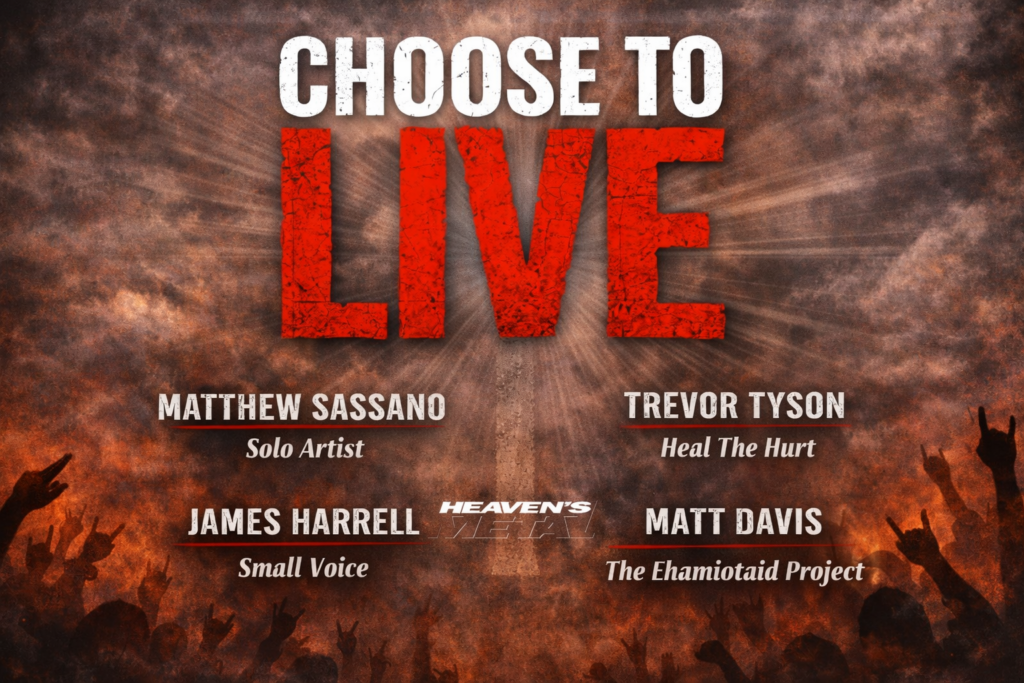
Choosing to Live
For decades, Christian hard rock and metal have provided a space where struggle is not hidden behind polished smiles. Long before mental health became a mainstream conversation in churches, heavy music was already giving people language for anxiety, trauma, burnout, and doubt.
Bands across the scene have wrestled openly with these themes. Artists like Demon Hunter, Memphis May Fire, August Burns Red, Wolves at the Gate, Islander, Convictions, Blue Fire Horizon, Red Calling, and Magdalene Rose have all contributed to a culture where honesty about internal battles is not seen as weakness.
Within this community, a phrase has begun appearing more frequently among artists and fans alike: #choosetolive. It is a simple phrase, but for many people it represents something profound—the daily decision to stay, to keep fighting, and to seek help rather than suffer alone.
The voices featured in this article come from different corners of the Christian heavy music community: musicians, advocates, and speakers who have faced mental health struggles personally and chosen to speak openly about them.
Their stories are not identical, but they share one conviction: healing begins when silence ends.
Jake Luhrs and the Call to Choose Life
Few voices in the Christian metal scene have spoken as openly about mental health as Jake Luhrs of August Burns Red.
Through interviews, public conversations, and his own outreach efforts, Luhrs has consistently emphasized the importance of honesty, community, and asking for help when life becomes overwhelming. His message resonates across the heavy music community because it rejects the idea that strength means pretending everything is fine.
Instead, he encourages people to confront struggles openly and pursue help when needed. That perspective has helped normalize conversations around anxiety, burnout, and emotional health for both artists and fans.
That same spirit of openness appears in the stories shared by the artists and advocates in this article.
Matthew Sassano
Christian solo artist, mental health advocate, and licensed mental health advocate whose music addresses disability, trauma, and recovery through deeply personal storytelling.
For Matthew Sassano, mental health is not a theoretical topic. It is something he has confronted since his teenage years.
Growing up in a pastor’s household, he experienced a sharp contrast between public faith and private turmoil.
“At the same time, behind the scenes, there was a lot of turbulence in my family life. Growing up, I remember knock-down, drag-out fights between my mom and dad, and fights between me and my dad. Things were intense at home — but then, in the very same day, we’d go to church, sing worship songs, hear a powerful message, and in a way, we’d become the ‘fix’ for everyone else’s problems.”
Eventually that pressure collapsed into a crisis that forced him to confront mental health directly.
“That was my first real encounter with mental health — not as an idea, but as something unavoidable and deeply personal.”
Isolation later became another challenge, particularly because of the physical limitations he lives with.
“Another big factor for me is isolation. Because I live with cerebral palsy and dyscalculia, I’ve never been able to drive… that limitation can still lead to isolation if I’m not careful.”
Over time, Sassano began developing practical habits that helped stabilize his mental health.
“What helps is staying productive, but also giving myself room to trust the process. Building meaningful relationships, surrounding myself with people who share similar goals, and allowing myself to rest without guilt are all important.”
Physical discipline also became part of that process.
“Another practical thing I do is try to stay physically active… when my body is in better shape and I have some kind of routine, things start to align mentally too.”
One of the most important lessons he has learned involves the relationship between faith and professional help.
“But when it comes to mental health, we often act like prayer is the only step required… prayer is incredibly important — but it’s not always a one-size-fits-all solution.”
He explains that faith and counseling should not be seen as opposing ideas.
“I believe faith and practical help can coexist. Counseling, accountability, routines, and prayer aren’t in competition with each other — they’re meant to work together.”
Much of Sassano’s music reflects these themes directly.
“A large portion of my catalog centers around mental health… Not My Name deals with disabilities and labels. Not Unreachable dives into anxiety. Happy Family addresses domestic abuse.”
Through performances in prisons, recovery events, and outreach festivals, he has seen how those stories resonate across very different life experiences.
“What I’ve learned is that pain is universal.”
Trevor Tyson – Heal The Hurt
Vocalist of Heal the Hurt, a band built around honesty, brotherhood, and confronting mental health directly.
For Trevor Tyson, the turning point came when anxiety and burnout manifested physically.
“Awareness has become one of the greatest tools in my life. You cannot heal what you refuse to acknowledge.”
Touring and performing bring incredible opportunities, but they also carry emotional demands.
“Band life is both beautiful and demanding.”
Tyson explains that the band intentionally created an environment where mental health conversations are normal.
“We have built a culture in Heal The Hurt where honesty is normal. If someone is struggling, we talk about it. Brotherhood is not pretending everything is fine. Brotherhood is making sure no one carries weight alone.”
Songwriting has also become a space where difficult emotions can be processed.
“Our songs are often born from the places most people try to hide.”
When someone feels overwhelmed but doesn’t know where to begin seeking help, Tyson offers a simple starting point.
“Start by telling one person you trust the WHOLE truth.”
His message to those quietly battling depression or anxiety is deeply personal.
“If you are reading this and quietly fighting a battle no one sees… you are not too far gone. You are not a burden. You are not disqualified from a meaningful life.”
And he ends with a reminder many people need to hear.
“Please choose to live. The world is better with you in it.”
James – Small Voice
Artist behind Small Voice whose album Testimonies explores anxiety, doubt, miscarriage, and spiritual struggle.
For James, mental health first became real after a panic attack at eighteen that resulted in an ambulance ride and months of uncertainty.
Over the years, he discovered that small daily habits could significantly affect emotional stability.
“Honestly, what helps me most that I’ve noticed is diet, and sleep.”
Creatively, anxiety has often fueled his songwriting.
“Honestly it’s a blessing and a curse… during those times is when I’m the most creative.”
His album Testimonies reflects the struggles he and others have faced.
“Yes, my entire album Testimonies is mostly themed around tough times I or friends have had.”
Balancing honesty with hope is something he continually works through.
“As a Christian, I tie the hope of Christ into it as best I can.”
When someone asks where to start in addressing mental health, his advice is straightforward.
“First I’d say to seek Christ… then talk to someone you trust.”
Despite years of navigating anxiety, his faith remains central.
“Im at a point in my mental health where my faith is what I lean on and all I really have.”
For him, #choosetolive carries a simple but determined meaning.
“#choosetolive for me means to never give up the fight.”
And for anyone ashamed of their struggles, he offers reassurance.
“Don’t be. You’d be surprised how many people deal with this.”
Matt Davis – The Ehamiotaid Project
Founder of The Ehamiotaid Project, an international speaking initiative dedicated to breaking the stigma surrounding mental health.
For Matt Davis, the path toward mental health awareness begins with three simple steps.
“The 3 steps I use to protect my mental and emotional wellbeing are knowing, acknowledging and accepting that I have mental health issues.”
His faith remains a core part of his resilience.
“My faith is what has kept me going all these years. It is my lifeline.”
He also encourages people to seek support from established organizations.
“NAMI… Celebrate Recovery… and The EHAMIOTAID Project.”
His advice for someone unsure where to begin is refreshingly direct.
“Talk to people. You will find common ground.”
For those struggling silently, Davis encourages honesty.
“Come out of hiding.”
And for anyone who feels overwhelmed by life’s ups and downs, he offers perspective.
“It is life. Welcome to it. It is tough. It is a roller coaster… Stay. The world is a better place with you in it.”
Choosing to Live
Different stories. Different journeys. Different perspectives on counseling, faith, discipline, and community.
Yet all four voices arrive at the same conclusion.
Mental health struggles are not evidence of weak faith. Silence does not create healing. And asking for help is not failure.
In a genre often known for its volume and intensity, Christian metal continues to offer something deeper: honesty.
And sometimes honesty is the first step toward survival.
Stay.
Tell the truth.
Seek help.
Choose to live.
About Author
