


Feature: The Wizard of Oz Dilemma – AI, Music, and the Art of Illusion
by Seth Metoyer, Heaven’s Metal Magazine
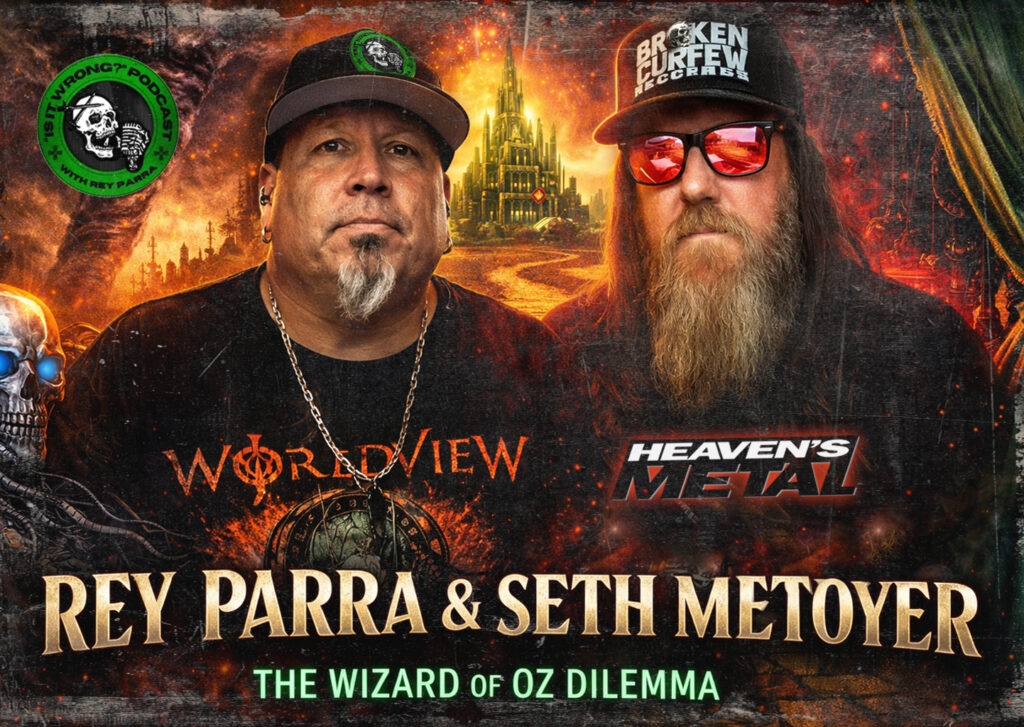
I recently joined Rey Parra on his Is It Wrong? Podcast for a conversation about AI in music, but the deeper issue turned out not to be technology alone. It was illusion, authorship, and disclosure. The increasingly blurry line between accepted studio craft and outright deception. What began as a discussion about AI quickly became something larger: how much of the curtain artists owe the audience, and when the mystery behind the work stops being part of the art and starts becoming a lie.
The conversation around AI has already become muddy. People throw around the term as if it means one thing, when in reality, they may be talking about generative prompt-made songs, drum programming, MIDI files, virtual instruments, stem splitting, smart mastering tools, or hybrid productions that still begin and end with a human being making the real creative decisions. The public’s ability to tell the difference is collapsing fast, and once that happens, suspicion fills the gap.
That’s where the “Wizard of Oz dilemma” comes in. Art has always had a curtain. Recorded music has always had one. The question now, more than ever, seems to be, what is actually going on back there?
Not Every Digital Tool Is AI
One of the biggest mistakes people make in this conversation is collapsing everything into one bucket. Drum machines are not new. MIDI is not new. Virtual instruments aren’t new. Digital editing is not new. Smart software that helps shape mixes and masters has already been part of the production world for years, and newer versions of many of those tools now include AI-assisted functions in the background. That doesn’t magically mean all digital production has become fraudulent.
This is where the discussion gets sloppy. Some listeners hear the phrase “AI music” and picture short, prompt-generated songs spit out by a machine in seconds. That is one category (some refer to it as AI slop, and for good reason). However, it’s not the only category. There is also AI-assisted production, where the artist is still recording, arranging, directing, editing, and shaping the final result. Then there are long-standing digital workflows that some people now call “AI” simply because they do not understand how modern production has worked for years.
That confusion creates a second problem. Once people become suspicious enough, they start accusing everything. A band uses a drum program, and somebody says it is AI. A band uses MIDI, and someone says it’s fake. A traditional recording artist is suddenly expected to “prove” authenticity to strangers online who often do not know the difference between programmed drums, sampled sounds, and generative content. To me, those people aren’t looking for clarity; they are panicking.
The Human at the Center
For me, this conversation isn’t theoretical. I have worked in music and creative industries for more than twenty-five years. I came up through graphic design and creative direction, expanded into audio engineering, music production, branding, visual design, and artist development, and now run Broken Curfew Records while working in multiple bands and creative lanes at once. I am not approaching this as a tech salesman. I am approaching it as someone who has watched technology reshape creative work for decades and has also used some of the newer tools firsthand.
Hybrid creation is still creation when a human being remains at the center of the process. In my own work, that can mean recording guitars, directing arrangements, writing lyrics, working with real bass performances from my brother, Kris Olson, drum programming, shaping vocals with licensed vocal transformers and performers to blend with my own vocals, and then selectively using tools to help get the production where I want it to go. In my visual work, it can mean using AI to help generate a starting point or texture, then taking that material into Photoshop and building, cutting, correcting, layering, and steering the piece until it becomes the thing I was actually after in the first place. That’s not “push a button, out pops a tune.” To me, that feels like authorship using tools to enhance the final product, giving listeners the best possible listening experience.
I talked about this on the podcast with examples from both music and design. With Dreams Over Texas (a doom metal project from myself and Heaven’s Metal Editor, Doug Van Pelt), for example, I described handling keyboards, guitar, programmed drums, and collaborative AI-assisted arrangements for vocals in a way that still depended on taste, vision, and real decision-making. I also described visual work where AI could help get me close to a style or concept, but not to the exact result a client wanted, until I stepped in with years of traditional design experience. That is the difference. The machine can assist. It cannot replace the human appetite, instinct, and judgment behind the work.
The Wizard of Oz Dilemma
The heart of the whole matter is not whether technology is involved. Technology has been involved for a long time. The heart of the matter is what the audience deserves to know.
That is where I keep coming back to the Wizard of Oz dilemma. Music has always involved illusion. Fans hear polished records, massive guitars, perfectly locked drums, layered vocals, cinematic atmosphere, and performances that sound larger than life. That didn’t begin with AI. It was already there in studio musicians, ghost players, editing, mixing tricks, vocal enhancement, arrangement choices, and producers who knew how to turn a rough demo into something towering. The record was always a crafted experience, not a security camera pointed at raw reality.
On the podcast, I used the example of hearing an old Motley Crue demo and then hearing what a producer, Bob Rock, can do to transform it into the finished album people remember. That transformation is part of the illusion. It has always been part of the illusion. The same can be said for session players stepping in when a band member cannot deliver in the studio, or for any number of long-accepted practices that fans either never knew about or quietly accepted because the final work still felt alive.
So how much of the curtain do artists owe the audience?
That is not a simple question. Artists owe honesty, but do they owe every page from the book of “magic tricks”? I don’t believe so. They don’t owe us a forensic breakdown of every plugin, patch, layer, tuning decision, vocal chain, edit, or enhancement. Some mystery belongs to art. Some mystery belongs to craft. Nobody watches a magician because they want the trick ruined before it lands (well, I know I don’t). At the same time, there is a difference between preserving wonder and making false claims. When the curtain stops protecting craft and starts hiding deception, the line has been crossed.
That is why I can say plainly that if someone uses fully generative AI, contributes nothing meaningful to the writing or creation, and then presents the result as a traditional band or as a wholly human performance, that’s full-on deception. But if an artist is working in a hybrid process, driving the vision, performing core elements, making decisions, using modern tools to shape and enhance the result, and being honest in broad terms about that reality, then we are in a very different territory. Also, if someone is releasing generative AI songs/albums, they should just say that. There’s a whole subculture of fans who love it, and there are people with disabilities who also want to create musical noises. I personally don’t have an issue with that. Just be honest about it when you do that.
What People Actually Fear
A lot of outrage around AI in music isn’t really about every possible use of technology. It is about slop.
It is about prompt-to-song output mills, generic music factories pumping out endless tracks, and fake bands with fake personas building catalogs at machine speed. It is about listeners feeling duped after they sincerely connected with something, only to find out later that what they thought was human expression was mostly machine output wrapped in human-looking packaging. That emotional reaction is real. People do not like feeling fooled.
But there is another truth people do not always want to admit: slop existed before AI. Disposable music existed before AI. Oversaturation existed before AI. Streaming platforms were already flooded. Major labels were already pouring money into promotion, playlists, placement, and visibility. Plenty of truly good music was already disappearing under an avalanche of mediocre music made by humans. AI didn’t invent artistic mediocrity. It just gave it a faster engine.
The loudest panic around AI is really panic about volume, cheapness, loss of trust, and weak curation. Those are real concerns, and they deserve serious discussion. But they also need better categories, otherwise we end up treating a human-led hybrid production the same as a disposable prompt-generated content mill, and those are simply not the same thing.
When Even the Evidence Gets Blurry
One of the stranger developments in this whole conversation is that even “proof” has become slippery. For a while, some people thought the solution was simple: show the stems, show the sessions, show the process. But even that is getting murkier now. AI tools can split stems. AI detectors are unreliable. Traditional production software is increasingly adding AI-assisted engines to mixing and mastering tools. In other words, the old lines of proof are no longer as stable as people assume.
That creates a new cultural problem. A traditional band may be asked to prove they are not AI. A listener may run a track through some shaky detector and think they now have a verdict. Someone may not play live, or be a solo project. Fans might hear programmed drums and decide they have exposed a fraud when all they have really exposed is their own lack of understanding. That confusion only deepens the suspicion and makes the audience more cynical.
Photography Already Lived Through This
Part of why I do not believe the sky is falling is that I have seen versions of this argument before.
Back in high school (1992), I was fascinated by photography and was the Yearbook photographer. I loved the darkroom process, the film handling, the developer baths, the care, the waiting, the risk of ruining a shot if you opened the camera too early or misjudged a step. It felt tactile, mysterious, and deeply hands-on. Years later, when I went back to visit my old teacher, the darkroom was gone. I was told they had “dry dark rooms” now. Everything was digital. The old ritual had changed. The tools had changed. The debate had changed. Suddenly, everyone had a camera, and everyone was a photographer.
Yet photography didn’t die.
Traditional photographers still existed. Fine art still existed. The widening of access created more noise, output, casual participation, and confusion over what counted as “real,” but it did not eliminate the person with the eye. The same questions showed up then that are showing up now. Is digital still photography? Is it still art? Does a new process erase the old one? The answer, then as now, is that new tools do not automatically destroy craft. They expose it.
The Human Spirit Still Has to Show Up
By the end of the conversation with Rey, one thing felt clear to me: AI is here. It is advancing whether people like it or not. The more useful response is not panic. It is discernment and drawing better lines. It’s about protecting authorship, consent, licensing, and honesty without flattening every modern tool into the same accusation.
This also means remembering something simple. Real creatives aren’t going to stop creating. A kid is still going to want to pick up a guitar. Someone is still going to sit behind a drum kit. Someone is still going to paint. Someone is still going to sing into a microphone because they have something in them that needs to come out. The machine may speed up parts of the process. It may assist. It may imitate. It may even confuse the room for a while. But it can’t replace the deeper hunger that drives a human being to make something in the first place. That part still has to show up.
Art has always had a curtain. Recorded music always has. Film always has. Photography always has. The issue is not the existence of activity behind the curtain, but rather when it ceases to protect the art and begins to mask a false representation. This constitutes the “Wizard of Oz” dilemma, and as AI continues to permeate music, design, film, and culture, its implications will only intensify.
Watch the full Is it Wrong? Podcast “A.I. Revolution” episode here:
About Author

1 thought on “Feature: The Wizard of Oz Dilemma – AI, Music, and the Art of Illusion”