


Feature: You Asked for Real Music. Here You Go.
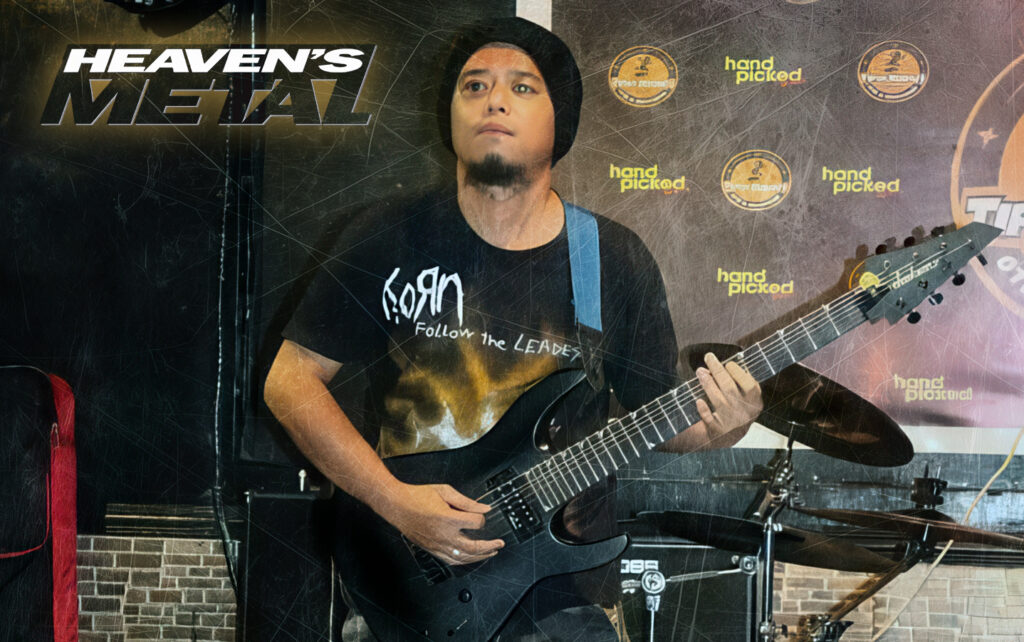
Philippine musician Jeri Tan has created four Christian metal projects spanning death, groove, gothic, and thrash metal. In an era obsessed with exposing artificial music, his work raises a more uncomfortable question: What happens when the independent human artist finally arrives?
“Support real musicians.” That has become one of the loudest battle cries in the growing backlash against AI-generated music. As streaming platforms, social media feeds, and music communities fill with hastily prompt-to-music generated tracks, critics often tell listeners to reject the slop and support human artists creating real music.
So, what do people do when an actual independent musician shows up and shares their music? In many Christian metal communities, the answer turns complicated almost immediately. Many will say the production sounds too homemade. The drums were programmed (dial 1-800-whaah). The mix and master lacks polish, the musician released too much material, the artwork looks amateurish or it’s too polished. And, if the cover art vaguely resembles something AI might create, even when no generative technology touched it, they get flamed.
Somewhere along the way, the call to support human creativity becomes another tribunal deciding which human creators qualify. Now the critics (and, as the old addage says, everyone is a critic) have an opportunity to practice what they preach.
Jeri Tan, a Christian metal musician from the province of Cavite in the Philippines, recently contacted Heaven’s Metal to share four separate projects: Abandoned Grave, Celestial Advocate, Joyful Repentance, and Damnation Terminator. When four projects from the same musician landed in front of us, the first question several writers asked felt immediate and thoroughly contemporary: “Is this AI?” I wondered the same thing, so I investigated.
Four Projects, One Immediate Suspicion
I dug into Jeri’s music from a somewhat different position than many Listeners might. I own an independent record label, work as a production engineer, and regularly hear music created through every imaginable combination of live performance, drum programming, editing, virtual instruments, samples, digital amplifiers, and modern production software. You name it. Ive heard it.
I also hold a more permissive view of AI-assisted production than some people within the metal community. The most relevant questions to me concern authorship, intent, transparency, and the actual creative work behind the recording. Still, four projects from one musician warranted a closer looksee.
I checked out a couple tracks from each project, expecting the answer to reveal itself fairly quickly. To my admitted surprise, I didn’t hear four AI-generated bands. I heard the recognizable work of one musician writing, recording, and exploring different corners of metal.
Across the four projects, I heard variations in guitar tone, pacing, arrangement, atmosphere, and production. I also heard the unmistakable continuity of a singluar songwriter. These projects actually sound a bit similar to me, which led me to another question as to why create four different bands when the projects sound similar (to my ears, anyway)?
I posed that question to Jeri and he explained that each name gives him a separate space to explore a particular metal genre.
“Well, I made four different projects to try out the metal genres that I currently want to explore during the time I was working on those songs,” he told me. “Death metal for Abandoned Grave, groove metal for Celestial Advocate, goth metal for Joyful Repentance, and thrash metal for Damnation Terminator.”
However, Listeners expecting four radically separate musical identities may hear some considerable overlap in styles.
From Secular Metal to Christian Metal
Jeri’s involvement with metal reaches back much further than these four projects. He traces his introduction to heavy music to the late 1990s and early 2000s, when bands such as Metallica, Korn, Black Sabbath, Pantera, Rammstein, Sevendust, and Limp Bizkit received local radio play in the Philippines.
By 2004, friends had introduced him to more extreme and atmospheric music, including Cannibal Corpse, Dimmu Borgir, Fear Factory, My Dying Bride, Cathedral, Hatebreed, and Within Temptation. In 2007, he formed his first serious band, performing material inspired by symphonic black metal groups such as Emperor, Satyricon, Old Man’s Child, and Dimmu Borgir.
His interests widened again around 2008 as he moved deeper into progressive metal and classic progressive rock through Dream Theater, Opeth, Meshuggah, Yes, Genesis, Pink Floyd, Gentle Giant, and Symphony X.
Jeri dates his Christian conversion to 2012, during his first teaching position at a Christian school. His relationship with faith later became complicated, and by 2017 he had returned to working across numerous secular metal projects. He states that Christmas Day 2024 as the decisive turning point.
“I started out as a secular metal musician here in the Philippines,” he explained to me, “but last year, 2025, I started making Christian metal and gradually stopped making the typical secular metal music.”
His four Bandcamp pages spotlight the projects as the work of Jericho Tan in Calabarzon, Philippines, and each carries the same Reformation-era declaration: “Sola Scriptura, Solus Christus, Sola Gratia, Sola Fide, Soli Deo Gloria.” For those who haven’t brushed up on their theology lately, those words translate to: Scripture alone. Christ alone. Grace alone. Faith alone. Glory to God alone.That statement seems to function as the theological foundation beneath all four projects.
Jeri describes himself plainly as a believer, a follower of Jesus Christ, a metal listener, and a metal musician. There appears to be little concern for constructing a complicated persona around the work. I like that raw, “I just love The Lord and Metal” approach.
When I asked what else he wanted Heaven’s Metal readers to understand about him and his projects, he returned to that purpose;
“Well, I think I do this for the glory of the Lord Jesus Christ,” he said. “Metal music is the only form of art I know how to do, and I’m using metal for the Lord Jesus’ exaltation.”
A Wide Musical Vocabulary
His influences stretch across several generations of Christian heavy music. Jeri cites foundational artists such as Stryper, Saint, Bloodgood, Barnabas, Whitecross, Barren Cross, and Saviour Machine. He also points toward Mortification, Living Sacrifice, Horde, Paramaecium, Becoming the Archetype, In the Midst of Lions, Vomitorial Corpulence, Abated Mass of Flesh, Cerimonial Sacred, and Brian “Head” Welch.
The list moves beyond metal into P.O.D., Flyleaf, Switchfoot, Five Iron Frenzy, Jars of Clay, Lifehouse, Casting Crowns, Lecrae, Trip Lee, Tedashii, Sho Baraka, Don Moen, Brooke Fraser, and Michael W. Smith.
Jeri’s musical imagination has formed through death metal brutality, thrash precision, gothic atmosphere, Christian hard rock, worship music, hip-hop, alternative rock, and progressive experimentation.
What “Support Real Artists” Actually Encompasses
Jeri’s music will probably invite legitimate criticism. Listeners will obviously evaluate the production, songwriting, performances, arrangements, artwork, and distinctions between the four projects. Supporting independent artists doesnt require abandoning critical judgment or pretending every release reaches the technical standard of a major-label production. But it does require intellectual consistency.
When people call for listeners to support human musicians, they also have to make room for the realities of human music. Human music includes programmed drums. It includes limited budgets, modest recording environments, unusual artwork, uneven production, stylistic repetition, and musicians who remain visibly engaged in the process of developing their voices.
A culture shouldn’t demand human imperfection as proof of authenticity and then punish musicians whenever those imperfections become audible. The arrival of AI-generated music has made listeners suspicious of productivity, polish, artwork, and even ambition. The independent artist enters a hall of mirrors where every sign of limitation becomes a failure and every sign of advancement becomes evidence of fraud.
Jeri Tan offers four projects created from a far simpler approach. He loves metal, follows Jesus and wants to explore the genres that shaped him and use them to exalt Christ.
Now comes the part where you can support him by checking out his music.
Listen to Jeri Tan’s Projects

Joyful Repentance — Gothic Metal
https://joyfulrepentance.bandcamp.com/

Damnation Terminator — Thrash Metal
https://damnationterminator.bandcamp.com/

Celestial Advocate — Groove Metal
https://celestialadvocate.bandcamp.com/

Abandoned Grave — Death Metal
https://abandonedgrave.bandcamp.com/
About Author
