


Review: A Death/Black Metal Fan’s Take on Saint and ‘Time’s End’
Look – when it comes to heavy metal, I’m not a traditionalist, and I never really have been. Outside of Megadeth’s Killing is My Business…and Business is Good,” I largely skipped over the Black Sabbaths and Metallicas of the metal world (I know, I know). Before Christian metal was really on my radar, my first serious heavy metal albums were ones by Nile, Cannibal Corpse, Cryptopsy, and Immortal. I’ve always liked my metal as extreme as it can get, and so a classic heavy metal band like Saint is normally not even on my radar, much like a band like Vomitorial Corpulence probably isn’t on someone else’s radar either. That said there’s something about Saint that I really dig.
Context is something I’ll always be talking about when it comes to many subjects – from Scripture to philosophy to music – and it’s something I’ll riff on here. Think about it – 1986. What was the state of Christian heavy metal? Bands like Stryper, Barnabas, Leviticus and Jerusalem were about as heavy as it would get. And then, along comes a band like Saint. Decked out in armour and rivets, and looking decidedly quite humourless, they didn’t look anywhere near the more friendly hard rock sounds of the day. Saint were different. And their second album, Time’s End, took Christian heavy metal for a darker turn, something far beyond anything hitherto explored.
No, Saint weren’t playing anything like thrash, let alone a kind of proto-death metal, but they were playing a form of music that, I think, would provide the impetus for more extreme metal styles to come to fruition. Think of it like this – a band like the Sonics from Seattle weren’t a punk band, nor a grunge band, but they laid the foundations for those styles of music to begin to grow with their over-the-top approach to garage rock that, for the time, was about as extreme as it could get. So too, I think, with Saint and their classic Time’s End.
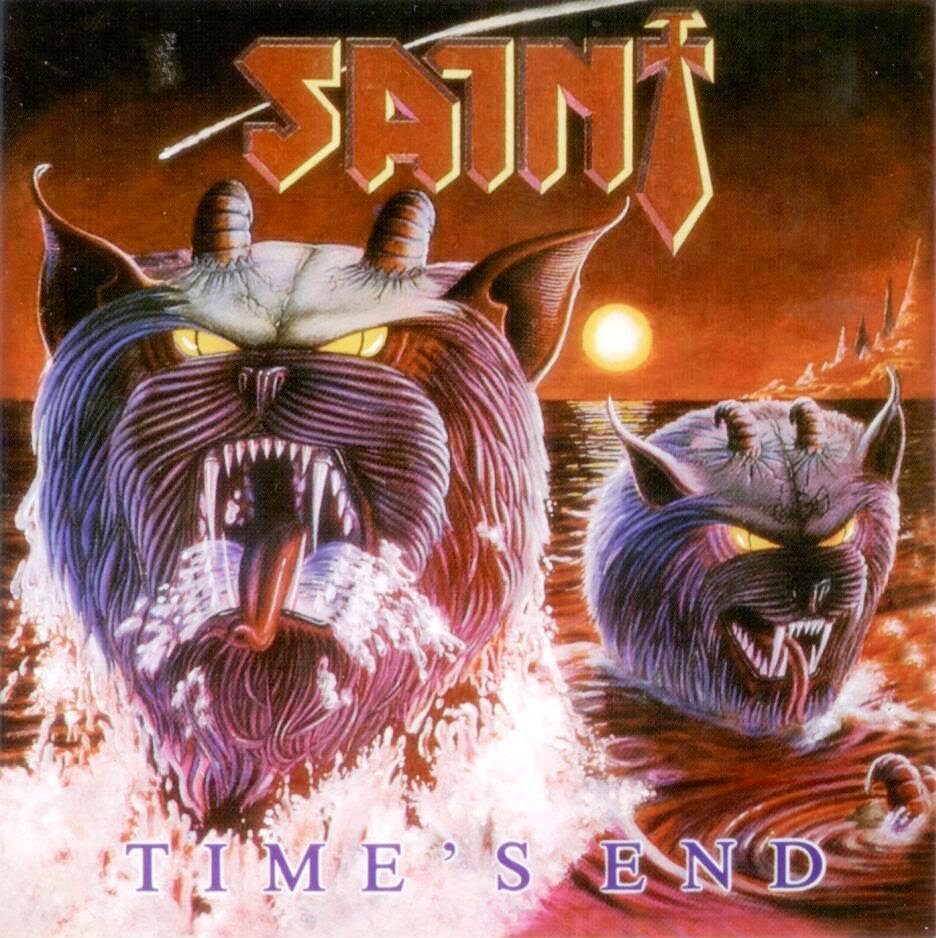
The infamous album cover alone was definitely an indicator of darker things in store, the image of a horrific three-headed beast (from St. John the Theologian’s Revelation, of course) rising out of the blood-red waters of what looks like a dying world hit all the right marks. And from the moment the first track begins, it’s obvious that this album is going in a direction that was hitherto unexplored.
The lyrics border on gruesome at times, pushing the envelope in such a way that I’m sure they rocked more than a few boats at the time. I’m sure you’re all familiar with the opening lines of the title track (“He wakes in darkness / The stench of burnt flesh fills the air / His chewed up body / The rats are crawling everywhere / He looks around him to his horror / Dead bodies rotting all around”), but tracks like “Phantom of the Galaxy,” “Destroyers of the World” and “In the Night” all feature some pretty violent and dark lyrics for their time (though the band does lighten things up on “Through You”). That’s not to say that Saint weren’t shining a light into the darkness like all great Christian metal bands do, but they weren’t afraid to touch on themes that, for the time, probably raised more than a few eyebrows for a Christian music world not yet ready for some serious heavy metal that could contend with its secular counterparts.
It took me a bit too warm to Josh Kramer’s vocals, admittedly. But watching some live footage of him onstage gave it all an extra appeal, thanks to his sweeping gestures and penchant for a rather theatrical stage presence. His menacing sneers and high-pitched wails all fit the style very well, providing a commanding presence over the music.
And though the band never ventures into the raw speed of thrash metal or the ramshackle violence of death metal’s earliest beginnings, Saint definitely stands out as a metal band interested in playing harder and heavier music than their Christian metal counterparts. From the ominous groove of “Steel Killer” to the driving “Into the Night,” it’s the sound of a band that’s deadly serious about their message and their music, and it shows.
For a death and black metal fan like myself, I think it says something that Saint’s Time’s End appeals to me so much. Though I would argue that extreme metal in particular (within the Christian scene) began with bands like Vengeance Rising, Incubus (aka Opprobrium), and Sacrament, I feel that Saint’s work here laid some very fertile groundwork for Christian metal to venture into much heavier territory. Time’s End sticks to a tried-and-true heavy metal style perfect for the traditionalists amongst the metal faithful and those who normally turn and run at the mere hint of a guttural growled vocal, but there’s a weightier sense of darkness and foreboding to Saint’s work here, a heavier tone and feel that appeals to someone like myself.
When it comes to someone of my tastes in metal, I began to think about how bands like the legendary secular black metal band Darkthrone don’t really talk about the genres (death, black, etc.) you would think they would be; instead drummer Fenriz is usually praising the far more traditional sounds of classic 80’s heavy and thrash metal, and frankly, those are the influences you’ll be hearing the most of on that band’s recent albums. In short, I picture Fenriz and Nocturno Culto blasting a record like this one in some forgotten log cabin somewhere on a cold Norwegian winter night, though in reality, the likelihood of that is obviously extremely remote given Saint’s status as a Christian band. But the point stands. Death and black metal bands don’t just cite death and black metal acts as influences or personal favourites to listen to, nor should they.
With Saint and Time’s End, Christian metal suddenly had an act that could match its secular counterparts using similar aesthetics, language and music. It’s a far darker record than anything that had been released up until that point, as far as I know, and its legacy paved the path for heavier music to come. For a black/death metal fan like me, that’s something.
For Fans Of: Judas Priest, Barren Cross, Accept, Messiah Prophet
About Author
