


News: ZAO Flagged for Generative AI as Music Enters a New Age of Suspicion

A veteran name in heavy music found itself in an unlikely position this week: defending its humanity.
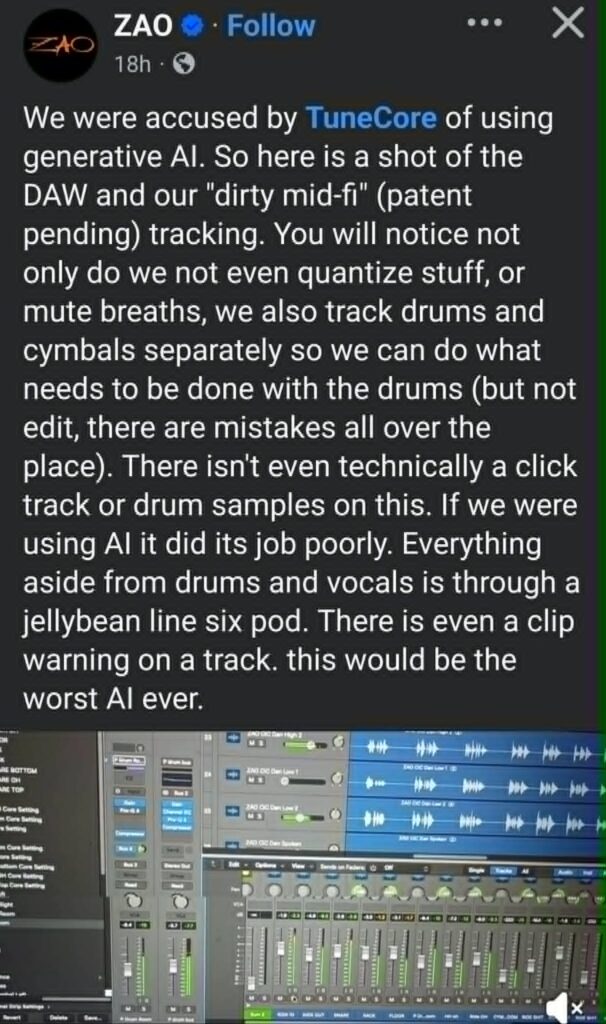
Metalcore pioneers ZAO, who don’t identify as a faith-based band but have a strong Christian metal following, shared a video from their digital audio workstation after distributor TuneCore flagged them for allegedly using generative AI. The post read less like a press statement and more like a studio confession. Tracks were left unquantized. Timing drifted. Breath noises remained. Drums and cymbals were tracked separately. There was no click track. Even a visible clipping warning made the cut.
“If we were using AI,” the band wrote, “it did its job poorly.”
The implication was clear. What once might have been considered flaws (imperfections in timing, dynamics, and execution) now serve as evidence of human involvement. In a landscape increasingly shaped by machine-assisted production, those rough edges have become a kind of authenticity marker.
*Since the initial post from Zao as screenshotted below was released, they added a disclaimer to the post saying “UPDATE: After blowing them up, all of a sudden they ‘fixed’ it and we are apparently back on track. We will see on June 26th.” So, indeed we shall see how things go when new music releases in June.
Zao’s situation isn’t isolated.
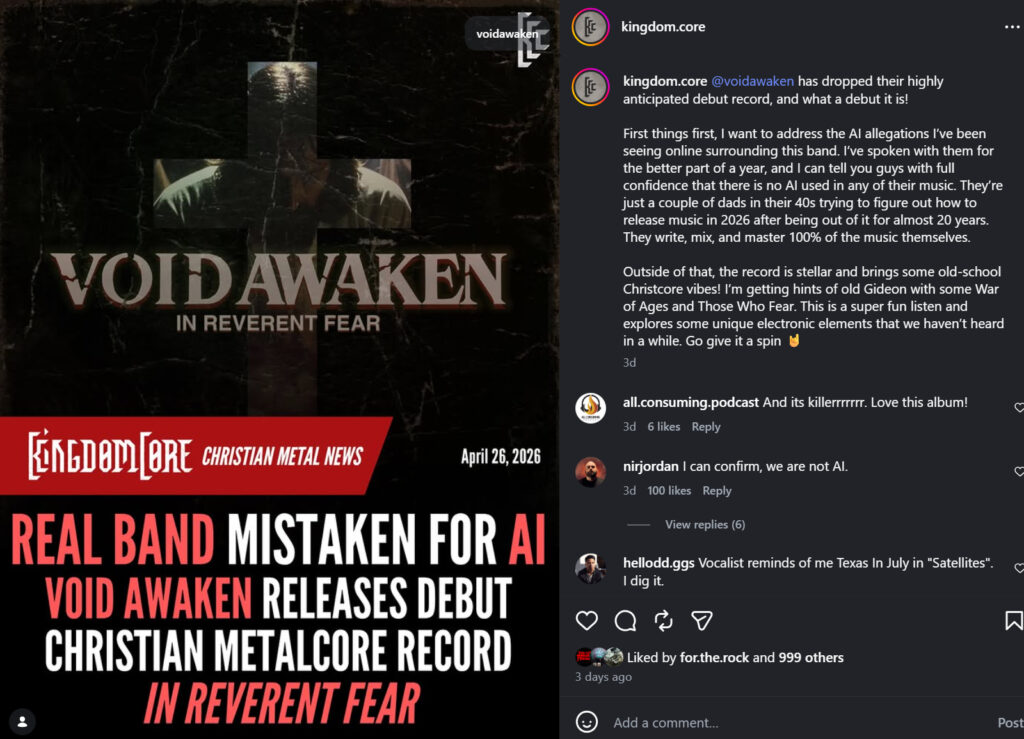
Earlier this week, Void Awaken, a newer act in the Christian metalcore space, faced similar accusations online (this time, by fans, and not an algorithm). The speculation centered on the band’s polished sound and cohesive production. Qualities that, in the current climate, can trigger suspicion as quickly as praise.
Christian metal outlet KingdomCore stepped in to investigate. After direct communication with the band, the outlet published a statement backing their legitimacy. According to KingdomCore, Void Awaken consists of experienced musicians, described as “a couple of dads in their 40s” returning to music after years away, who write, record, and produce their material independently.
“They write, mix, and master 100% of the music themselves,” the post read, encouraging listeners to judge the record on its own merits rather than speculation.
Two bands. Two very different positions in the scene. One shared problem.
The accusations point to a broader shift in how music is being evaluated in the age of artificial intelligence. The presence of AI tools in creative workflows has blurred the line between traditional production and generative creation. For listeners, that ambiguity has introduced a new kind of scrutiny, one that often unfolds in public, and sometimes without evidence.
Historically, metal has wrestled with similar debates. Triggered drums, pitch correction, and digital editing all sparked controversy when they first entered the studio. Each innovation raised questions about authenticity before eventually becoming part of the accepted production landscape.
At the same time, the technology continues to evolve at a pace that outstrips clear definition. Modern digital audio workstations and plugins increasingly incorporate machine learning features. Tools that assist with mixing, mastering, timing correction, and sound design. These systems analyze audio, make decisions, and adapt in ways that resemble intelligence, even if they operate within controlled parameters.
For working musicians, these tools aren’t theoretical. They are practical. They streamline workflows, improve consistency, and expand creative possibilities. In many cases, they function as extensions of the engineer rather than replacements for the artist.
That nuance, however, often disappears in public discourse.
The result is a growing number of “false positives,” where traditional recordings, sometimes intentionally raw, sometimes meticulously produced, are misidentified as AI-generated. The ear, once considered the final authority, no longer offers a reliable distinction. Precision can come from discipline, editing, or automation. Texture can originate from analog gear, digital plugins, or generative processes.
For artists, that uncertainty introduces a new burden: explanation. Zao responded by opening the session. Void Awaken relied on third-party verification. Both approaches reflect a shift in expectation, where musicians are increasingly asked to prove their process rather than simply present their work.
For platforms and distributors, the issue raises practical questions. As AI-generated music becomes more prevalent, systems designed to detect it will likely become more aggressive, and, at times, imperfect. The possibility of mislabeling or wrongful flagging presents challenges not just for artists, but for the infrastructure that supports them.
Industry observers expect streaming services to address the issue directly. Labeling systems similar to those used on social media platforms for AI-generated images and video could extend to music. Filters allowing users to include or exclude AI-assisted content may follow.
If that happens, the definition of “AI music” will become critical. A fully generated track is quite different from a traditional recording that uses machine learning AI tools for auto-tuning, vocal effects, VST instruments, and mixing or mastering. Without clear definitions, broad labels can blur those differences and unfairly impact artists working within established production practices.
For now, the conversation remains unsettled.
Zao’s response, imperfect tracks and all, serves as a reminder of what still defines the core of the medium. Human performance carries inconsistencies that no system fully replicates. Timing shifts. Dynamics fluctuate. Energy rises and falls in ways that resist complete control.
Listeners recognize that instinctively, even when the technical language escapes them.
The tension between innovation and authenticity is not new to music. What has changed is the speed at which that tension escalates, and the stakes attached to it. In an environment where a polished mix can trigger suspicion, and a raw recording can function as defense, the definition of “real” continues to evolve.
For bands like Zao and Void Awaken, the answer remains grounded in the same place it always has: the work itself.
About Author

Well written Seth. As much as I want this to be more black and white, you’ve shown us again that a) it’s complicated and b) the discussion is not going away anytime soon.