


Review: Vengeance Rising – Anthology (In Memorial edition)
By Jason McLaren
*These reflections are my own. I do not intend to speak for Heaven’s Metal Magazine on the subject, nor any of the Karew, who I am sure all have their own views on this. Further, my views here are not intended to speak for or represent the Orthodox Church of which I am a member. I only speak for myself, and my sole aim is to offer some food for thought on a difficult subject that I’ve been mulling over for a while now..*
I never knew Roger Martinez. When he was scaring the daylights out of the metal scene back in the late 80’s, I was a little kid. I didn’t even know what heavy metal was, and most of my first encounters with it in any church setting as I grew up were of the “metal is evil and will get your house haunted” variety. But I am someone who professed Christian beliefs growing up, only to later reject them with as much energy and conviction as I could muster. Roger Martinez’s fall away from his Christian faith is something I can somewhat identify with, and in that spirit, I wish to offer a few thoughts about it alongside my review of this In Memorial reissue of the classic Vengeance Rising Anthology.
Without a doubt, Vengeance Rising and Roger Martinez are, in my view, the reason why we have extreme Christian metal. Though Christians were already playing hard rock and heavy metal by the time Vengeance Rising came on the scene with their classic debut, Human Sacrifice, Martinez and company took Christian metal to an entirely new level of ferocity. Finally, the Christian metal scene had a musical answer to the more extreme sounds of bands like Slayer, Possessed, and the like. Add to that the absolute force of nature that was the band’s MC5/At the Drive-In—like stage presence, and you had a winning, and exciting, combination. From the histrionic thrash violence of Human Sacrifice, to the death/thrash heaviness of Released Upon the Earth, Vengeance Rising’s extreme sound would spawn a whole host of later bands that would follow in their footsteps.
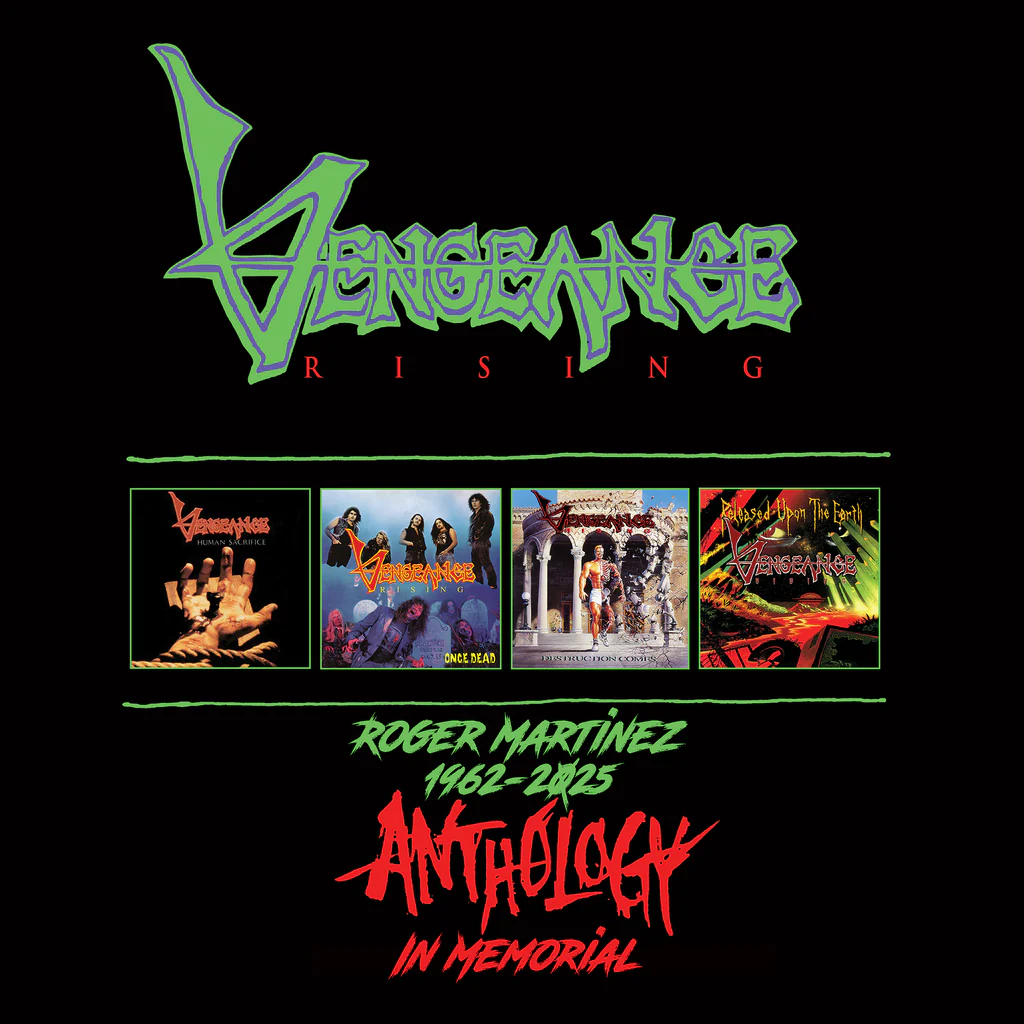
Now personally, I love compilations. There’s an art form to making them, from mixtapes to best-of’s like this one, and I’m happy to say that this one largely succeeds on every front. We’ve got four albums to sample from here, 3 cuts from each one with the exception of their sophomore release, Once Dead, which gets 4 tracks. Why this is, is a mystery to me; we all know Human Sacrifice is the album the band is known for, their classic. If any album should get the lion’s share of the representation on this record, I’d reckon it should be that one. But hey, no compilation is perfect, and in the end, it all comes out in the wash, as the material on Once Dead is my favourite here.
To the tracks, then. Human Sacrifice’s unhinged thrash going-off-the-rails sound is represented by the classic title track, of course, but also the groovy swagger of “Mulligan’s Stew” and the vicious “White Throne.” Personally, I would have skipped “Mulligan’s Stew” in favour of “Fatal Delay” and slapped “Receive Him” on the end to cap it all off, but that’s me.
The Once Dead material comes next (thanks to the reordering of tracks on this edition into chronological order, a great choice), and I have to say that this section is my favourite. “Warfare” and “Can’t Get Out” all hit with some really hard thrash, but it’s the crossover punk/thrash of “Out of the Will” and the threatening sounds of “Into the Abyss” that really steal the show here. “Into the Abyss,” with its menacing groove and terrifying vocals, has to be one of the downright best tracks ever, a milestone of Christian extreme metal’s early days.
Of course, we all know by now, I think what happened next to the band. The next, and final, two records came out after the band essentially disintegrated, leaving Roger Martinez largely alone to continue on under the Vengeance Rising name, supported by session musicians galore. There is a noticeable dip in song structure quality here with these next tracks, a loss of the dynamic edge and frantic violence that so characterized the band’s first two records. Most of these songs essentially all begin in the same manner, with the same chords and largely very similar openings. That said, the material on display here from the latter-two Vengeance Rising albums is still stellar, in my view, and only suffers when compared to the earlier work.
Destruction Comes is noticeably less muscular than its predecessors, a leaner beast altogether in many respects. But the Sacrament-style gang shouts of “Countless Corpses” and the lacerating thrash of “Before the Time” and “You Can’t Stop It” all make for some awesome thrash that, in some respects, dials the proto-death metal elements of the band’s earlier material back a little. Make no mistake, this is some nasty thrash that leans far more to the heavier side of the genre, but Martinez’s vocals feel more snarled than roared here, making for a different feel. Where earlier material was all over the place in terms of speed and structure, here we see Vengeance Rising in a more streamlined form, one that drives the songs ever onward over the proverbial cliff.
Lastly, we have the most controversial album, Released Upon the Earth. Here is where Vengeance Rising opts for a death/thrash hybrid sound, with Martinez adopting a death metal growl alongside his more traditional snarls (sometimes, Martinez’s vocals remind me a little of Glen Benton’s from Deicide). For a death metal fan like myself, I dig this approach a lot. Certainly, it does feel a bit restrained at times when compared to previous records, but I like the attempt to lean into a more death metal-like sound here. Released Upon the Earth is represented by “You Will Be Hated,” “Bishop of Souls,” and “Instruments of Death.” The compilation is topped off by an awesome little interview snippet with the band which really captures the excitement surrounding how this band approached not only its music, but its fans and even its detractors with a Christian message.
From all accounts, Vengeance Rising’s frontman would prove to be a tremendous influence on the lives of many Christian hard rock and heavy metal fans who yearned for extreme music that aligned with their Christian values and beliefs. The man’s influence changed a lot of lives – just a simple perusal of the comments on any Youtube video of the band are a quick testament to that fact. So it’s pretty heartbreaking to see what would happen later in his life; to watch the about face shift to aligning with the Church of Satan and eventually full-on atheism is hard to witness, I think, for so many. If you will permit me a few thoughts on the matter?
In reading through The Commonitory of St. Vincent of Lerins (a foundational text in early patristic writing on discerning heresy from orthodox belief), I read this: “…in the Church of God the teacher’s error is the people’s trial.”1 Here, St. Vincent is referring to two of the greatest writers and thinkers of the early Church – Origen and Tertullian, both of whom would later fall into heresy. Both were tremendously influential to both Latin and Greek Christian thought, both were foundational to Latin and Greek theology, but both remain problematic figures whose genius and whose faith would inspire so many, but also be the cause of others falling away from the faith. Let me be very clear – no, I am not saying that Roger Martinez is another Origen or Tertullian in terms of stature and influence; I’m simply drawing a comparison of sorts. I am saying that within his sphere, he was very influential, and someone that many looked up to for inspiration, and yet tragically, someone who would come to later abandon his faith for something counterfeit; such events would shake many a fan, rattle the Christian metal scene, and prove an easy target for critics to jump on. But my point is, this has happened before to some of the greatest figures in Christian history, and we shouldn’t be surprised that it continues, and will continue to happen to others as well.
In doing a little further looking into it all, what I personally found most saddening was what Roger Martinez seemed to be rejecting as such. I felt somewhat the same when I read our own Seth Metoyer’s thoughtful interview with the equally-thoughtful Zack Plunkett of Abated Mass of Flesh, and I kept mulling it all over in my head, thinking to myself “I wonder if they would or would have felt different when presented with a different take on Christianity than perhaps they encountered or were raised with.” In some of the post-Christian interviews with Martinez that I watched, he mostly seemed to speak about the concept of a loving God threatening millions of people with hell and eternal torment if they didn’t choose Him, and I thought to myself, “You’re getting this all wrong. Is this what you were told? Is this what you were taught?” Such a view seemed like a God that I too had issues with. It was the distorted view spoken about later by Martinez in these later interviews that was the kind of God peddled by pop atheist authors and/or edgy pseudo-nihilists. It was a caricature, a “god” who simply delighted in the death of the wicked, when the Bible specifically says the opposite (cf. Ezekiel 33:11).
Here, I can only offer my own personal thoughts on the matter, thoughts that I have no doubt many will disagree with on some level, but I hope will take in the humble spirit in which they are offered.
In the Orthodox Church, I’ve often heard God referred to as philanthropos, “the lover of mankind.” And nowhere in the famous words of St. John the Theologian do we read “For God so hated the world…” but rather “For God so loved the world that he gave his one and only Son, that whoever believes in him shall not perish but have eternal life.” (John 3:16 NIV) St. Irenaeus of Lyons (2nd. Cent) writes that “In His immeasurable love, He became what we are in order to make us what He is.” 2 Further, “God recapitulated in Himself that ancient handiwork of His, which is man, in order to kill sin, to destroy death, and to give life to man.”3 I wonder if Martinez would have thought differently had he been presented with a view of Christianity, specifically, perhaps, a view of the atonement as such that was different than the penal substitutionary atonement theory he was most likely presented with. Would he have taken a different course? I suppose we’ll never know. But it’s why I strongly feel that it is so important to educate oneself in not only the Scriptures, but their surrounding context – history, theology, spirituality, and all the rest. Knowledge does not save, obviously, but a well-rounded view informed by different Christian perspectives may have helped assuage Martinez’s fall from the faith as a whole.
In the end, we always have the hope that he had a change of heart. I do, and I’m sure pretty much everyone reading this article does too. And just because someone fell from the faith doesn’t mean we simply throw it all out or treat all of the music of this man and the band as dross to be disregarded; frankly, I highly, highly doubt any readers/fans would do such a thing. I say, take the inspiration of the man in his time and the music of Vengeance Rising for what it is. If you’re new to the band, this Anthology of Vengeance Rising is a fantastic place to start, especially given how physical copies of the band’s albums seem to be becoming rarer these days.
Vengeance Rising blew the doors off for Christian metal to become something that could truly stand up to the increasingly dark and nihilistic sounds of the rising next wave of thrash, death and black metal bands that would come to be. For that, I for one as a metal fan, am grateful. But I will always wonder, in the back of my mind – what if Roger Martinez had been presented with a different take?
For Fans Of: Ultimatum, Sacrament, Possessed, Slayer, Dark Angel, Incubus (aka Opprobrium), Possession
Footnotes:
1 – Commonitory, XVII
2 – qtd. in The Scandal of the Incarnation, 54.
3 – ibid., 58.
About Author
